Miriam Saperstein
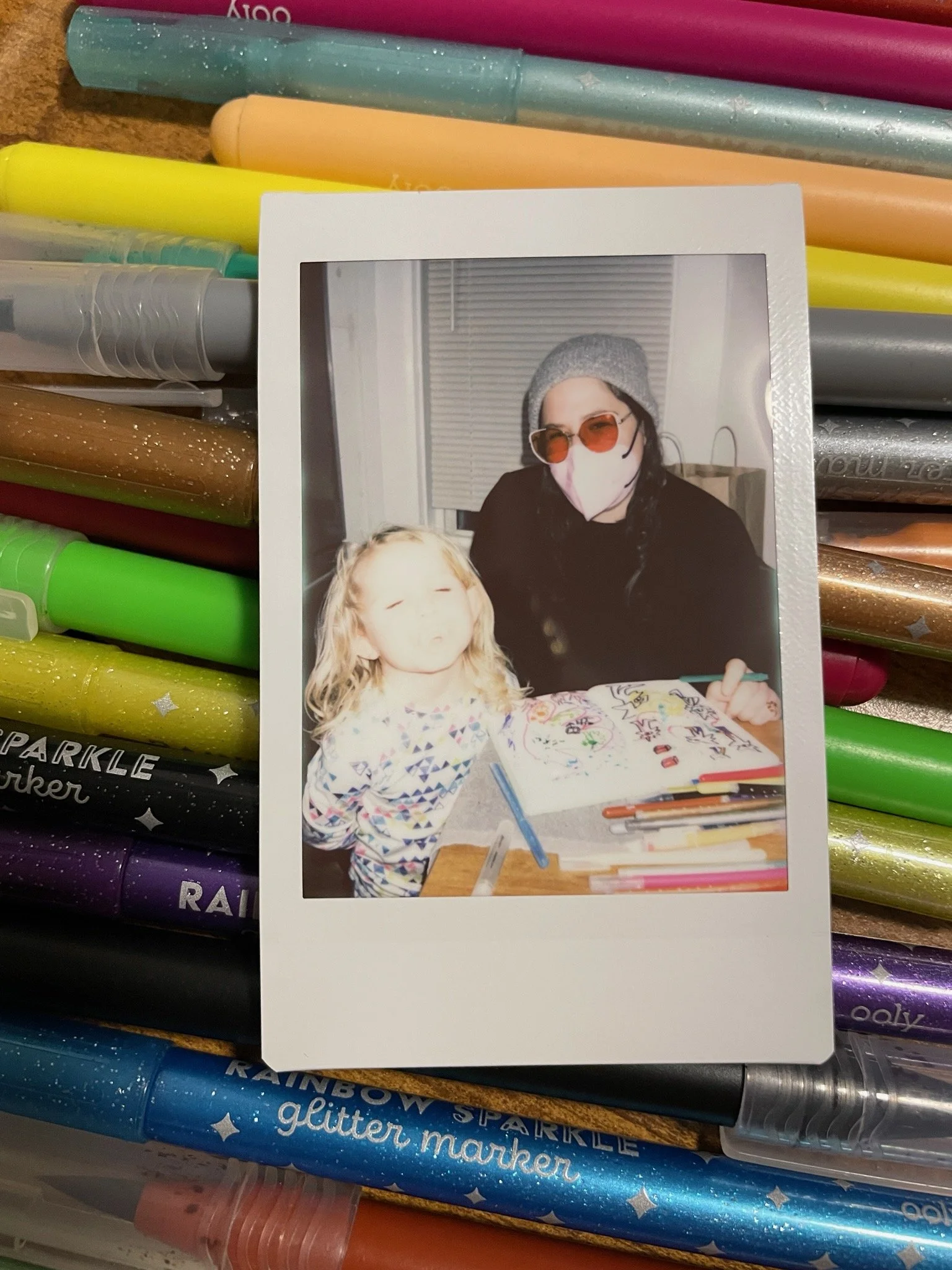
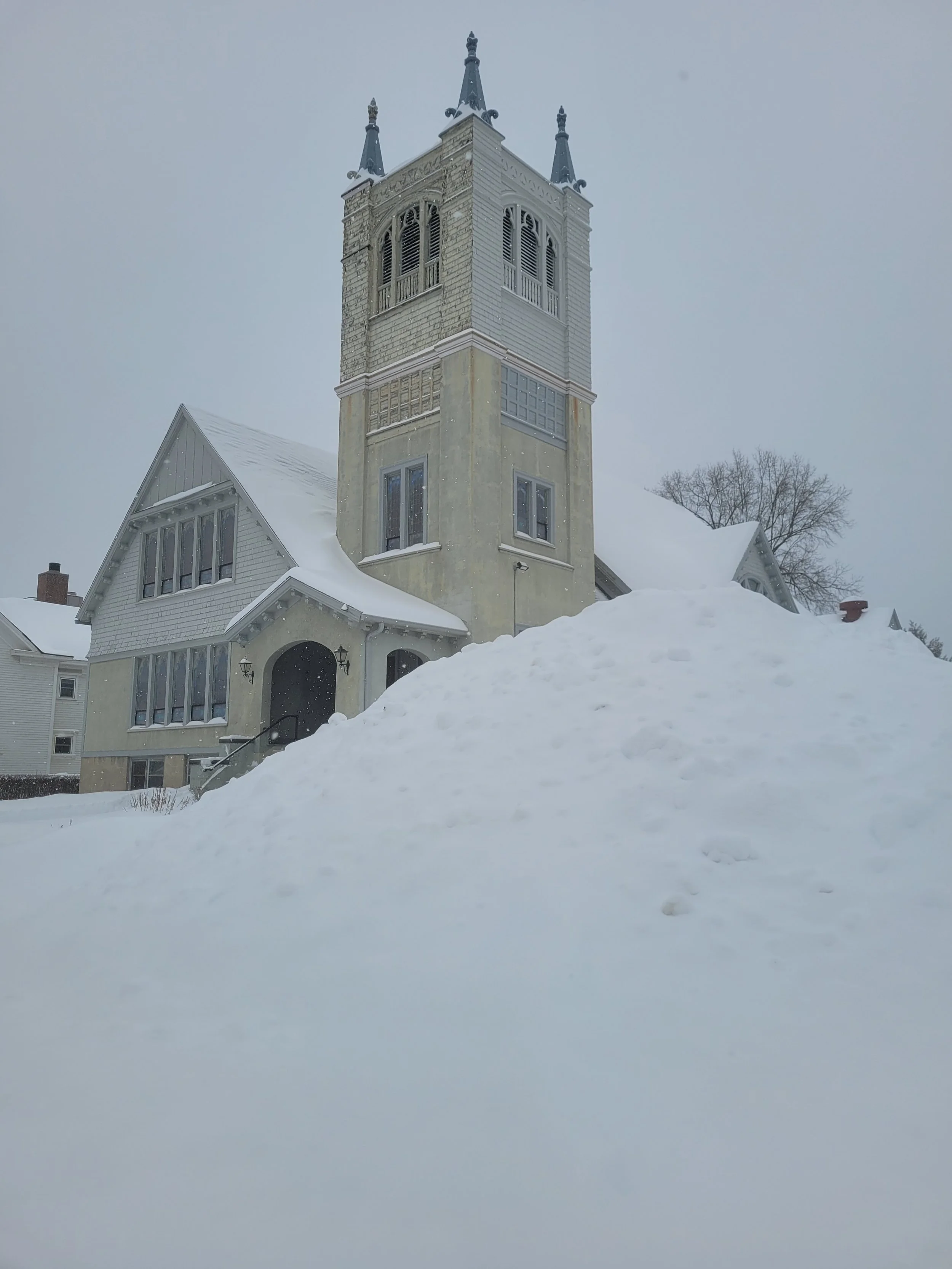
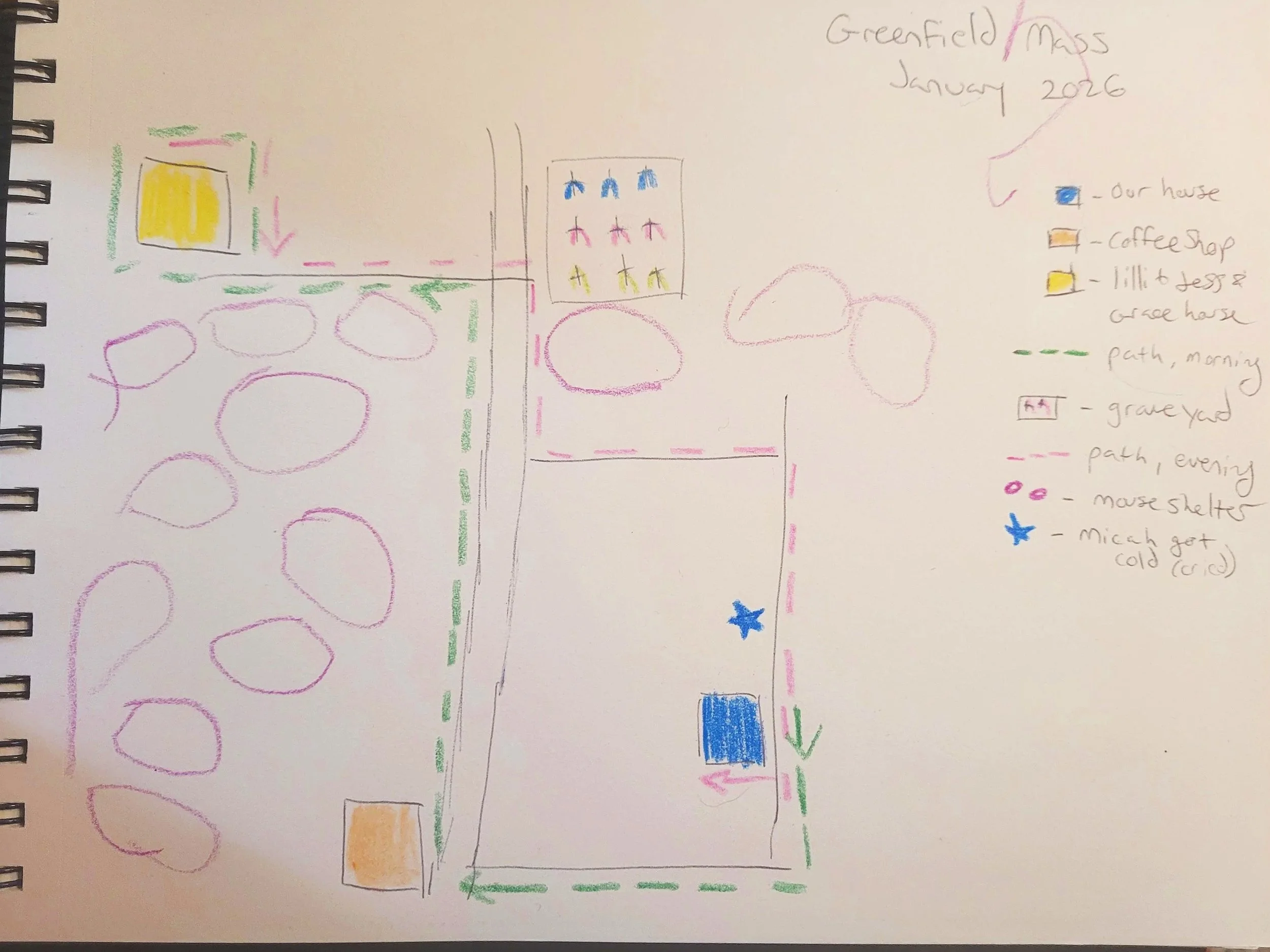
The first interview on my journey is with writer, environmental artist and zine-maker Miriam Saperstein. I met Miriam last summer at School of the Alternative, where we pretty immediately teamed up to put on a gallery show (side note, they’ll be back at SoTA this summer to teach a class on Access Artistry Portal(s) – applications are open until March 5th, don’t miss it!). This conversation took place in a rental apartment in Greenfield, Mass, where we were holed up during the January 2026 snowstorm. Miriam drove up to see us through a foot of snow, and we cooked dinner and colored little monstrous creatures together while we talked.
This conversation has been lightly edited for length and clarity. You can find Miriam online at miriamsaperstein.com. For follow-up reading, see:
Margaret Noodin, professor and poet.
Upstream - Place-based collective publishing in Philadelphia
Judith Berger - Herbal Rituals: Recipes for Everyday Living
Anna Tsing, “Contaminated Diversity in ‘Slow Disturbance’: Potential Collaborators
Rafe Neis, professor and author at UMich
Brian Teare, poet
Michael Medeiros, grief artist
Zoe Tuck, poet
V: I'm also curious how you think about your project ancestors. I think this is something that I see a lot in your art, and I would love to hear you talk about. Who has given you parts of your practice that you're now carrying on?
M: Yeah. A big part of how I relate to place-based art-- and I do a lot of history about place, about situating myself in time --
M: Some of my, people that I'm thinking of are, well, Margaret Noodin really introduced me to a lot of stuff about indigenous watershed mapping, because I took a class. After Covid lockdown, I was still in school, meeting online, and it overlapped with the George Floyd protest starting in Detroit. So we were in class every day, but online, [with] people throughout Michigan. Meg was our teacher, and she was teaching this class about Anishinaabemowin, which is the Ojibwe language. She's a linguist, and she studies how the language can be kept alive through teaching it actively and using it. So--
M: So this class was about how the naming convention in Anishinaabemowin is verb-based. So you're describing a relationship to something as you're describing the thing itself. And the world is animate, so in this cosmology, the name of a creature or a rock or whatever is gonna to– it kind of nouns as a verb.
V: Is there an example that can help me?
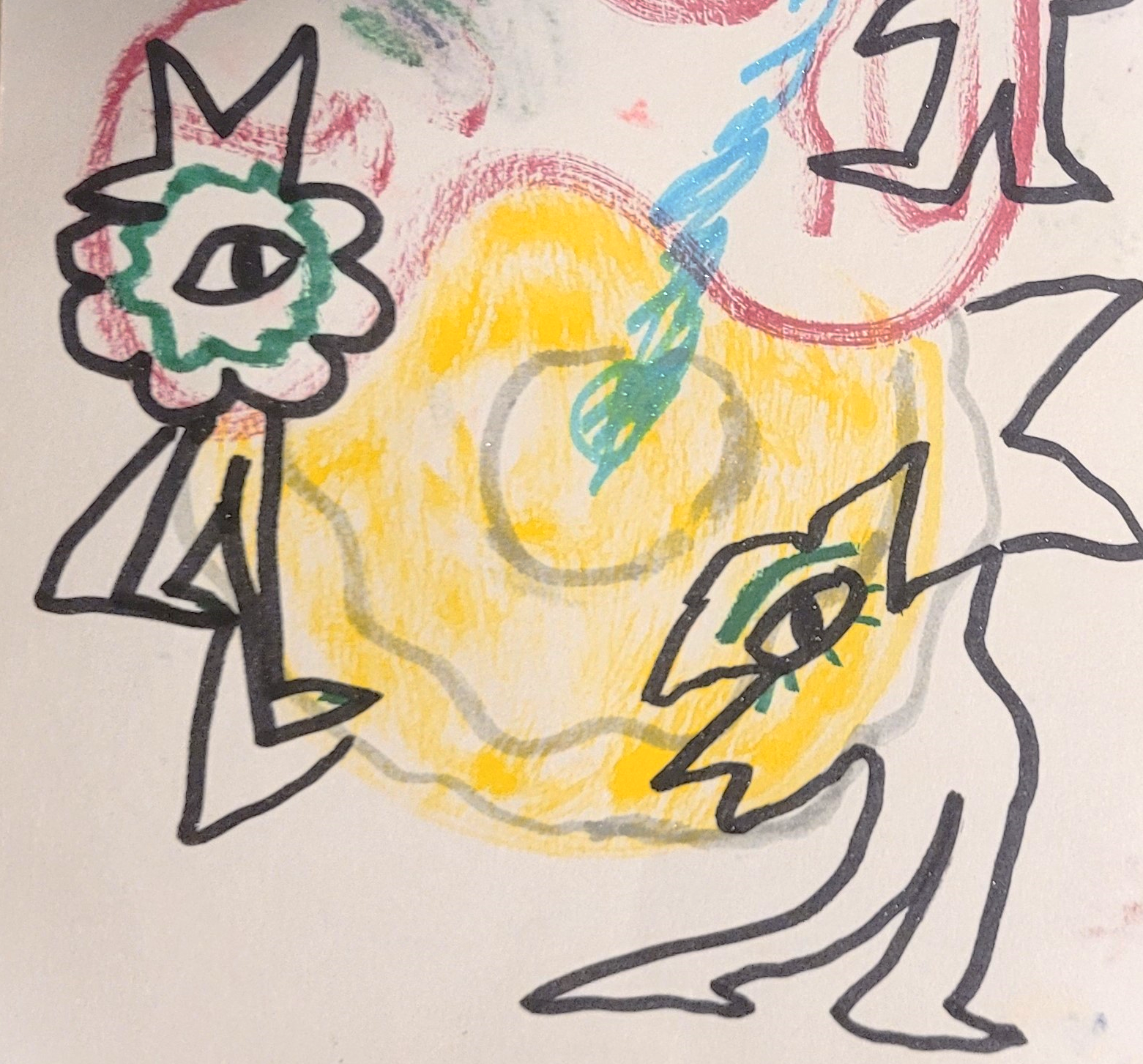
V: Miriam is one of the top creators of little creatures of all time, much like our friend Rosie. Like, little creatures are integral to your work.
M: Yeah, they really are. Zoe says that I see them by drawing them. And I'm like, yeah, I do. I don't picture them ahead of time.
V: That's Lynda Barry core!
M: Yeah!
V: Something else I'm interested in is the idea of cousin projects, or projects that you know have a shared ancestor to you.
M: Yes. Oh, wait. Can I say a few more teachers?
V: Please, I want all of it.
M: Okay, so another one is these women who are exorcists in the Pale Of settlement, they're called opshprekherins, and they were speaking off the evil eye, and they have this very kind of ecological --
M: So these women that I was talking about, their spells were stolen, but the spells still exist because of that, and also because people still practice it in sort of remote areas of Poland and other parts where people were doing this. They have this system where the evil eye is tangible and acts on different things, so it can be cast upon you by someone's gaze, or by doing the wrong thing, or drawing attention to your illness or something. But it's very ecological and cellular, because it's like, what is inside and outside? How permeable is the boundary between inside and outside, whether it's domestic, within a gender, within a relationship? These boundaries are very porous, but mediated. And so these people were basically using holy text and names of God and different storytelling techniques to take off the evil eye from someone who is sick, and heal them. So it's, both medical and also spiritual healing. And they had counterparts within non-Jewish culture too. Like, there are people doing similar practices, but not with biblical Hebrew, they were using their own Bible text, or whatever other sort of textual or oral traditions. And they were also using plants. And some of the choreography involves, like, rolling eggs or other stuff. So there's this very rich world.
And they also have very similar syntax to other moments of Jewish incantational magic, like the demon bowls that I was talking about. These bowls would be used to trap demons. And I've been learning a lot from the idea of the ecology of the demons themselves. My friend asked me, how do they decompose once they're trapped in the bowl? And so I have a whole piece in Upstream, which just came out– It’s a really cool, super new place-based, Philadelphia-based collective publishing thing that just started, and they have a website now, and they're going to make some print things too. But they publish a piece of mine that's basically imagining what happens in a demon bowl.
V: I'm really into conceptually thinking about decomposition as artistic practice, or artistic process, one that I could do very little in, but that I have animal and fungi and water friends who are really good at doing.
M: Yeah. I feel like also, a lot of my teachers have been the river that I lived near when I was really sick, or plants that I'm learning. And then another eco artist ancestor is Judith Berger, who wrote this book called Herbal Rituals that I read during lockdown. That's this raised in New York, Orthodox woman who is writing about the Wheel of the Year, very New Age-y, sort of influenced by both appropriated indigenous culture and herbalism from Ireland, sort of hodgepodge of stuff. But she writes this book that's an herbalist guide to the year that has cultural background–
M: Anna Tsing is also a huge influence on my work with contamination. And then in terms of the Jewish stuff, the ecology, Rafe Neis was my teacher in undergrad who introduced me to critical Talmud studies. And that's been really influential as well. They study sight and reproduction within species, within Jewish texts. And they're also a visual comic artist and painter who is an academic, but really rad, a really cool person. So that's another person that I feel is really influential.
There's so many moments, place-based and time-based work. Some sibling projects are, my friend Mike is doing really cool stuff with grief. and is working with materials that washed up on shore, bricks that washed up on shore in New Bedford after he had a dream about the same thing. And is working to build sculptures of extravagance, and is just a really rad person. I feel like there's a lot of kindred spirits. This Upstream Collective is really great, they're doing really cool stuff. I feel like everyone that I've danced with in the woods or done ritual with...Zoe is a huge collaborator for me right now, and wrote a whole book this summer that's going to be published by next year. It's incredible. It's so good. I just feel like I've been growing her more ecological side.
V: Some of us are indoors kids and some of us are outdoors kids...[laughs]
M: Yeah, she's like, a reader.
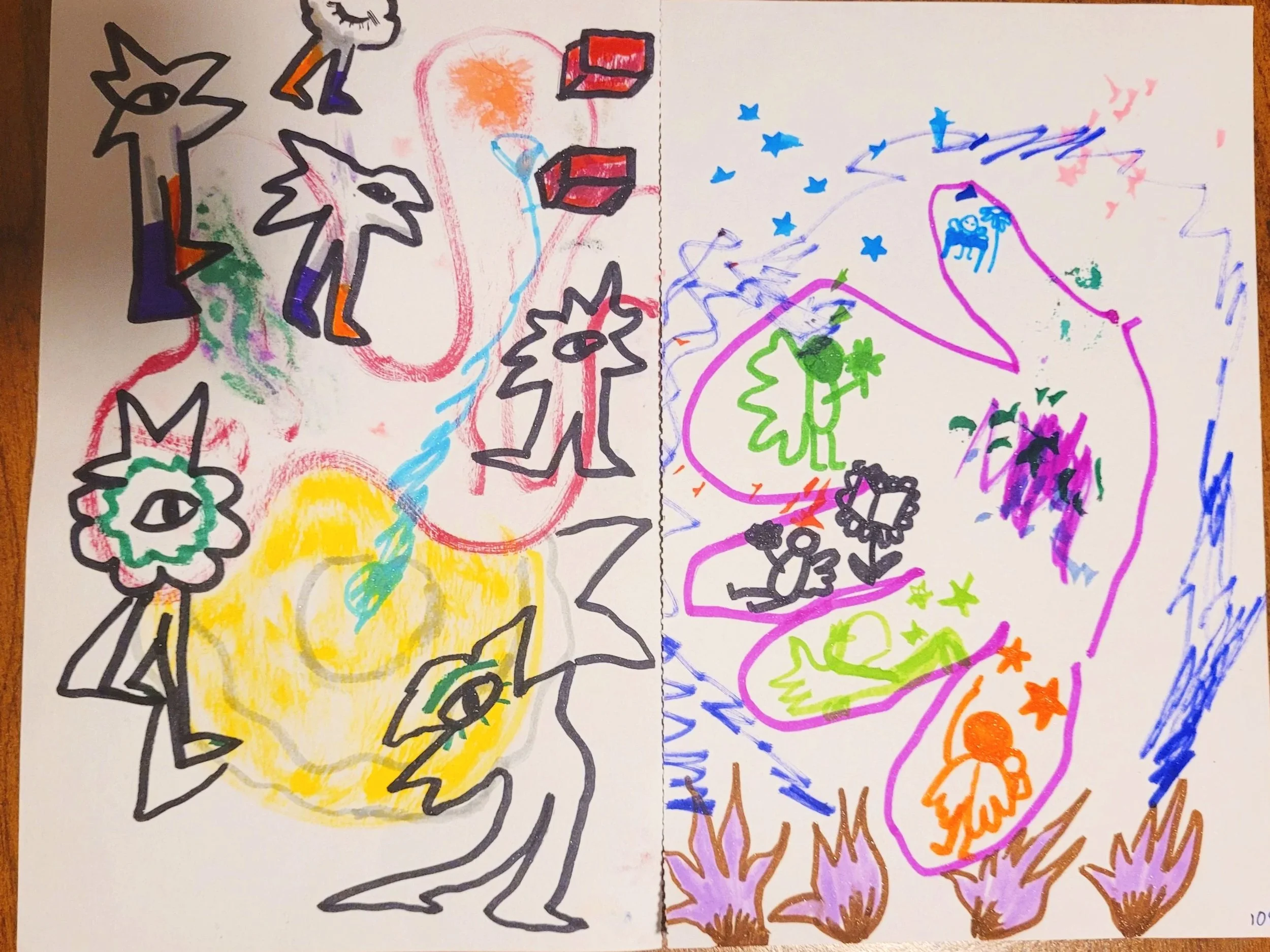
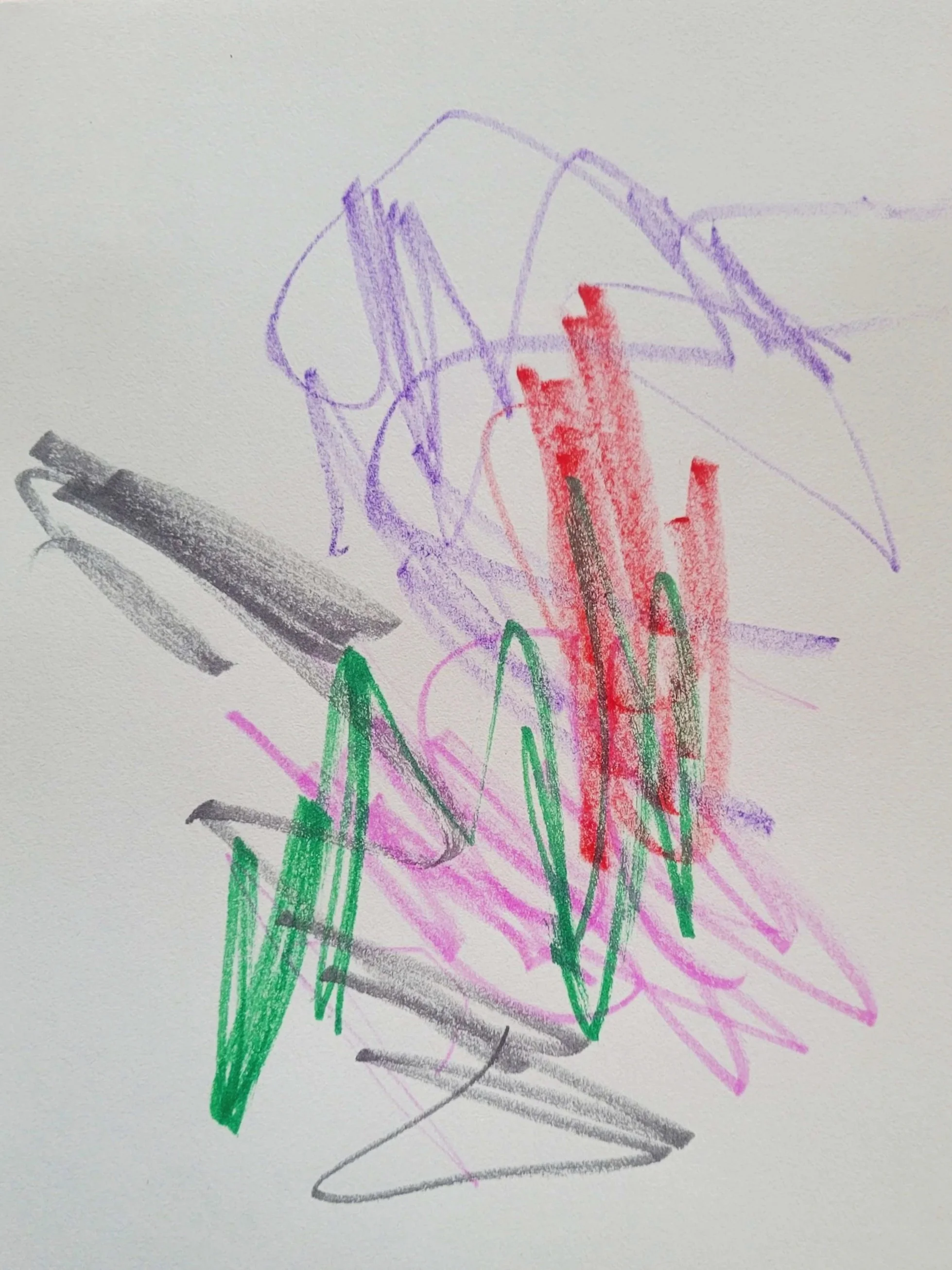
Elinor, age 4: I cannot try, I cannot, I cannot draw unicorns,
MS: You cannot? Do you draw other things?
E: Yeah, yeah.
M: Would you like to share these markers?
E: I don't have those kinds.
M: You could use them while I'm drawing with them. You can ask if you want to use any of them at all.
E: I do not know how to draw hearts or stars or anything...well, just drawings and people that look crazy.
M: Maybe they use their nose to figure out where they are in space. They don't need eyeballs. Maybe wings.
E: I do not know how to draw butterflies or fairies yet. Since I'm four.
M: Oh, you know, you could make something up, if you wanted to make up a new way to draw them that you can do. Should the nose have a nose on it, or is the nose its own nose?
E: For my little sister's birthday. We went to a museum.
M: That's really cool. What did you see at the museum?
E: Well, mostly good stuff and not bad stuff and not boring stuff.
E: I linked the stars to my pathway.
M: Oh, nice. Yeah, it's good to follow the stars of the pathway. You know, sometimes people look up at the sky to do that, because they'll look and they'll know certain constellations are like one of the directions they want to go in. So they'll follow that constellation.
E: These stars are making it appear,
M: Yeah, Do you know about the Big Dipper?
E: Yeah, I certainly know about it….That color is great. You can do it in here and here.
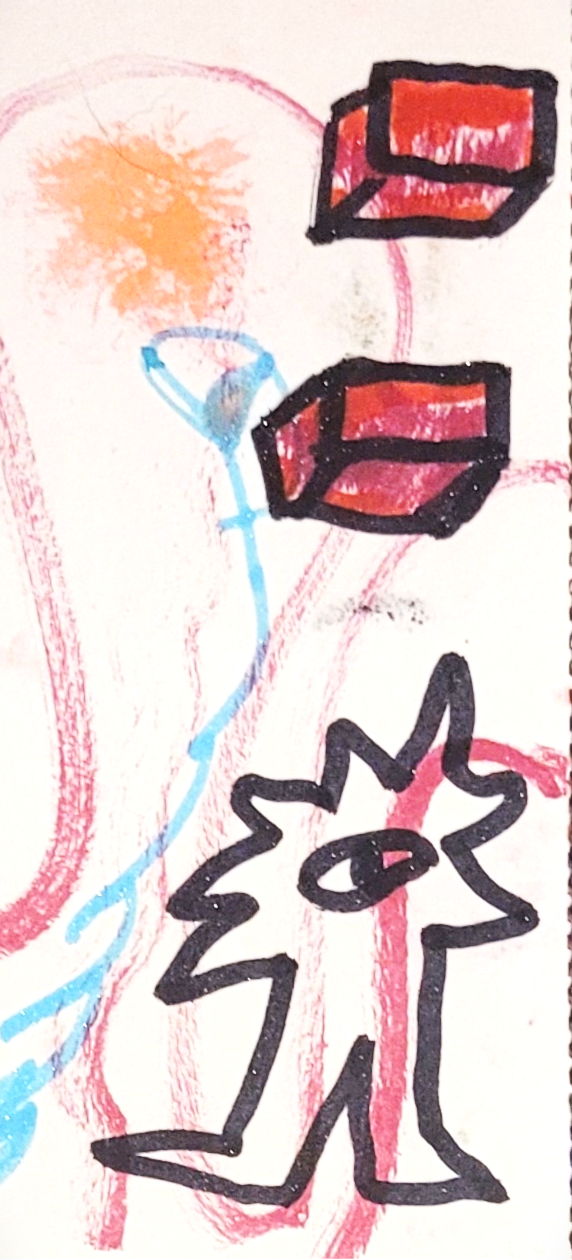
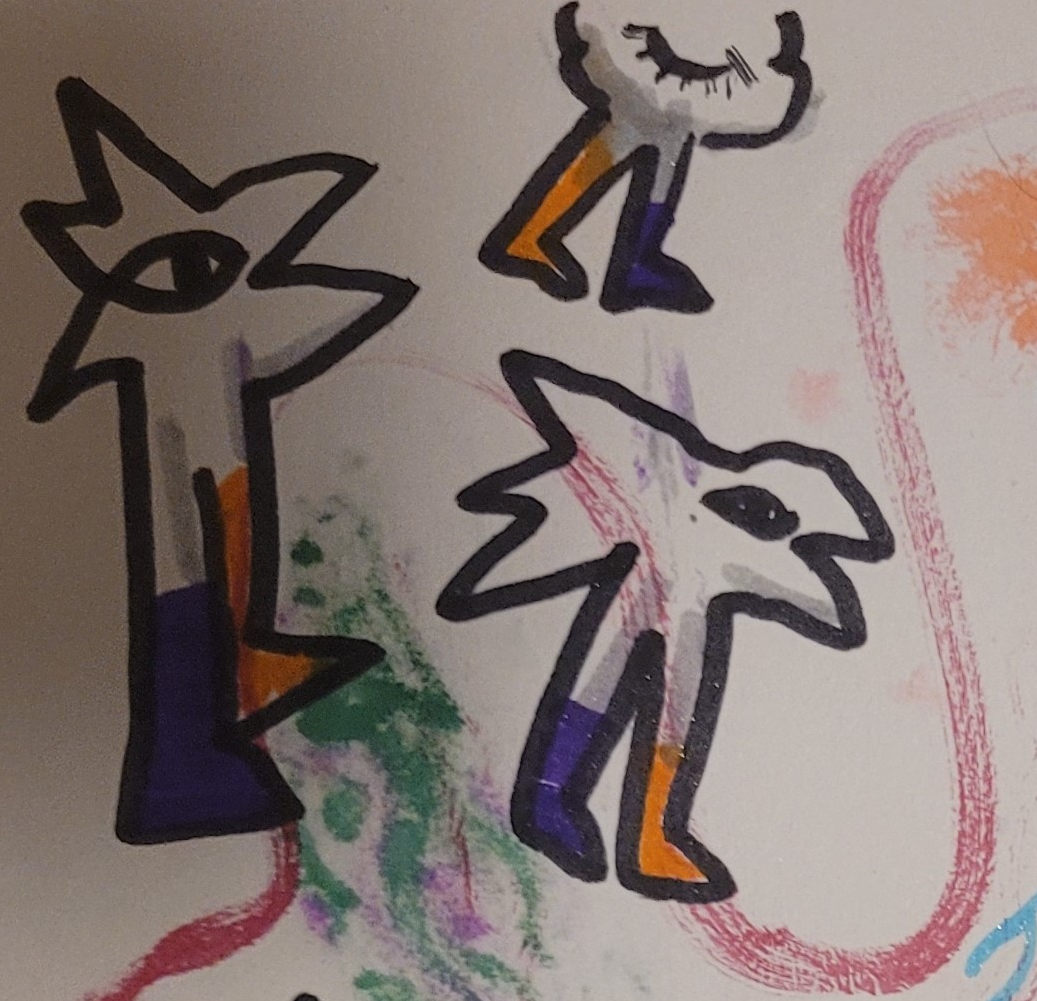
M: Oh, yeah, what if I do a little creature in here?
E: Like a fox.
M: Like a fox? I'll give this one a fox head.
E: It's not supposed to be big.
M: Oh well, this one got a little big.
E: That's fine.
M: I can do another littler fox. This one kind of looks like it has a cow head. Didn't really turn out like a fox.
E: No! It looks great.
M: Thank you. I like to draw little creatures.
E: I told her that I know the big dipper!
V: Yeah, that's a constellation, although my friend Miriam is like me and uses 'they' instead of 'she' just so, you know. Are there other constellations you know, Elinor?
E: Oh yeah, like the bear that lost its tail, that was trying to get fish.
V: Yeah, Ursa Major is one name for that one.
M: You know, there's a story about a bear from the area where I'm from, where there was a bear that was running away, and she laid down to protect her two baby bear cubs, and they became sand dunes. Have you ever seen a sand dune?
E: Yeah, I saw a lot of that stuff in this movie about space.
Troy Spindler: Are you talking about Tatooine and Star Wars?
E: Mmhmm. You told me about sand dunes.
TS: You saw some sand dunes when you were really little, when we went up to Prince Edward Island.
E: That's in Star Wars, and the Big Dipper is in Star Wars...At the end!
T: In the credits?
E: Yeah.
M: I added a flower and a little decoration. I think the path you made with the stars is really beautiful. Have you ever tried to draw your hand?
E: I do finger painting with my hand.
M: That is a really smart way to do it, because then it looks the same shape as your hand. Sometimes I try to draw my hands, and they turn out really weird when I try to draw them.
E: I do on paper perfectly. Just like, trace it.
M: Oh, yeah. Do you want to show me how you trace it? I drew some creatures and some maps. And wait, this one turned out really cool. And this guy, I really like.
E: I'll just show you how to make something really beautiful.
M: I'm just adding a little head and then a circle for the body…
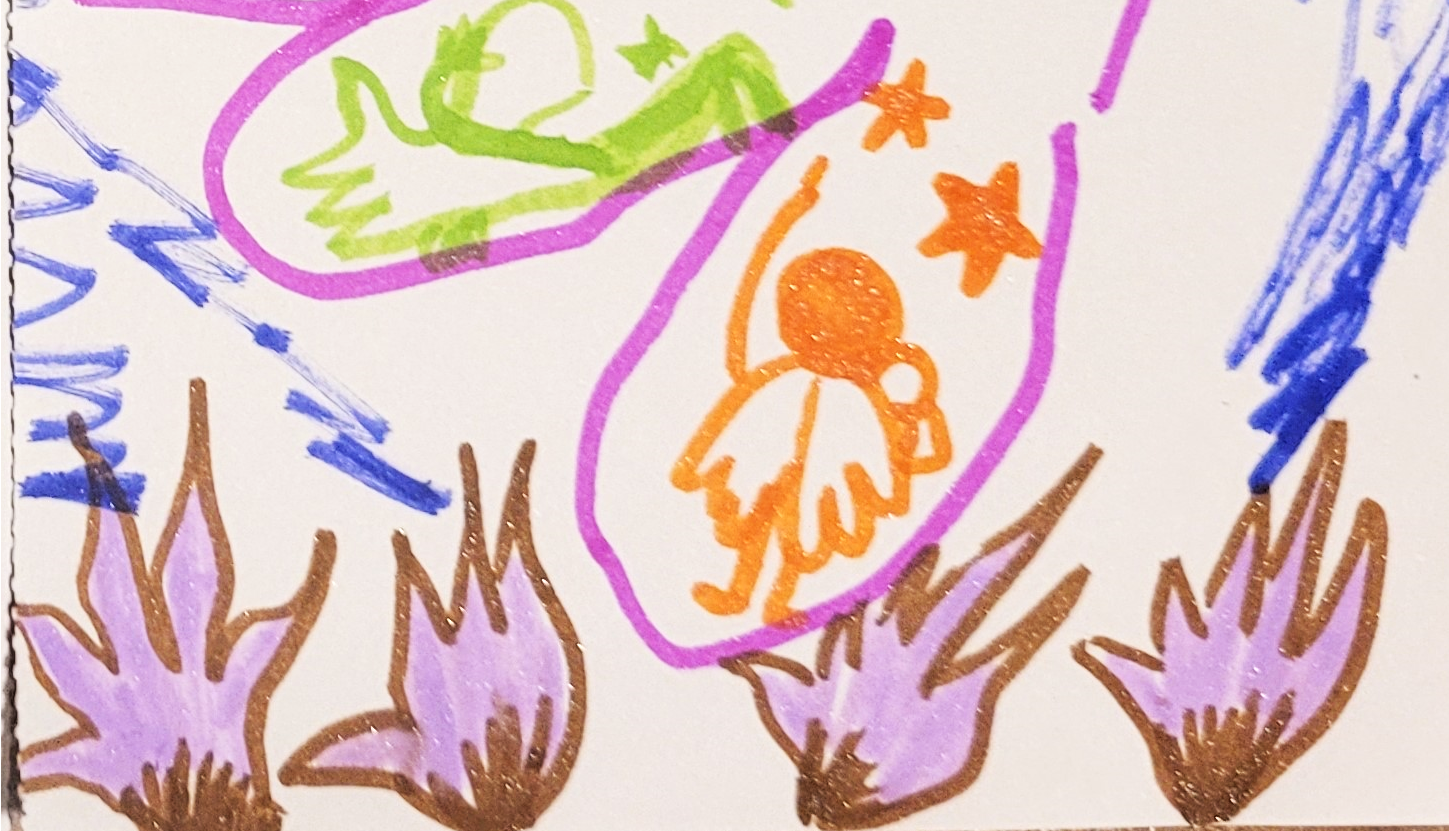
E: This one's the baby...the baby can stand but cannot walk yet…This is where the mama is.
M: Yeah, I think the mama is gonna be reading a book.
E: Yeah, it's fine, yeah. The sister is going to be reading a flower shaped book, too.
M: Oh, a flower shaped book, yeah…
E: This is where the dada is.
M: Is there a baba too?
E: Yeah, there is. Here's a mama, and a baba. It's fine if the dad turned out weird.
M: Well, I'm trying to draw them so they're kind of like leaning back on one arm, and then holding their head with the other and they're looking at the stars...
E: Stars up in the sky?
M: Nice. You can make your own constellation. How is orange? Well, thank you for your artistic direction. What is the baba doing?
E: Well, he's just looking, looking at the sky, at the sky, feeding another baby.
M: Okay, so the baby's over here, being held, and then, with the other hand, you're coming up at the stars and showing the baby, yeah,
E: In the baby's bed, the mama can stay in there too.
V. We love a big bed. This is one of the biggest beds I've ever seen.
E: He's reading-- the flower book is all about her baby sister, the one that her mama's feeding. He's reading it back. And I did this. I did this eyes, and it was little hearts. So hearts coming out the fairy are green.
M: Nice! Green like the fairy.
E: The baby is thinking about what the sister is doing, and she's thinking, Wow, it's so great that he's thinking something. It's so great and happy.
E: The mama's power is to change up into the stars so people will know that she's a magical fairy.
M: Cool.
[baby shrieks]
E: This blue thing is a curse that's all going to her…
M: Oh no! What's the curse?
E: It keeps her asleep. But I'm just making it!
M: Maybe there's something in her dreams that work will tell her how to break the curse. You ever get dreams like that, that tell you information?
E: No, I only get dreams that are scary, and not fine for me.
M: Yeah. I'm gonna draw a dream for her where she learns about what might help her break out of the curse. She might need that. Maybe you can help me interpret this dream.
E: Here's yellow, just in case. You can color this dream yellow. Like it's a magic dream.
V: Do you know what the word interpret means?
M: You know what I mean when I say that?
E: No.
M: It means to make a story out of something that you see or hear, and you kind of make up your own version of what it means. Like if I say, can you interpret this yellow drawing?
E: Magic...there's magic coming out of it. To another pond. Yeah, it's smaller, but still a pond,
M: Yeah. So when I interpret this, I could tell you, this is a yellow flower, because I'm making a story out of the picture. That's an interpretation.
E: Yeah, it's beautiful. So we have to go see a monster. That's nice, but has bad memories. Of his past. And she lives with his siblings.
M: Yeah? What do they do with the memories from their past?
E: Well, they're like, their mama died from big monsters throwing bricks at her. And then he only had his dada.
M: Yeah. Maybe they have a special dance for remembering their mama. Want to draw them doing a dance?
E: Well, their mama is in dance class. And they start throwing bricks at her.
M: Oh, no.
E: Don't worry, they are just bad guys.
V: I'm wondering, as someone who works with natural materials, and has an ecological perspective, if you could talk a little bit about how you use technology and the digital world.
M: Yes! Very, sort of frustratingly, because I can't look at LCD screens anymore because I get migraines from them. They flicker at a rate that is faster than what our brains can comprehend. And my brain is already working overboard to correct for my eyes seeing at different heights, so I really can't add in that element. So it's really shifted. I was getting really into game design when I first got this sort of, for my blast out of Covid… I've been doing this thing where I am trying to work with scanners and stuff to do less, because my handwriting can sometimes be a little experimental. So I'll draw something on paper, scan it, print it out, and then do a collage with those materials. And it also allows you to work with more legible text for zine making, stuff like that.
V: We love a legible zine.
M: Yes! No, really, I've learned the hard way. And so I do a lot of stuff like that lately that's been really fun. And I'm interested in ink-making too. I've made a lot of inks from plants that I've collected, and want to get more into dye-making as well, but it's very slow. It's learning one plant at a time, like, this is something in my neighborhood. How does it work? What kind of colors does it make?
Last year, when I was really sick, I grew a dye garden, but I couldn't go outside every day because it was really unsafe heat and air quality. So sometimes my friends would water it. Sometimes it wouldn't get watered. But I collected the flowers whenever I was well enough to go outside, and then dry them, and then I made inks out of them. But I added soda ash to them to change the pH, and they all went rancid really fast. So I try not to be too precious about it, but I think ink-making and more contained versions of pigment-making with material, or doing it in site and then photographing it, I think is going to be more my speed now. Because I really love to get immersed in the meditative act of assembling stuff. But I just don't think I can save those materials in my house anymore, because of the mold stuff. Because as lovely as decomposition is, I shouldn't be breathing it in as much as I was. And I write a lot about rivers because I lived alongside a very sick creek that was downstream of a Superfund site… And I was very sick. The environment was making me very sick. And this river was very sick, and I just walked alongside it when I could and kind of like, reverse anthropomorphized myself? Identifying with the river, and have written a lot about that river.
Another sort of sibling project is Brian Teare, the disabled poet who wrote about the same rivers as me. Like, the same watershed.
E: This kinda looks beautiful.
M: Yeah. Would you like me to take this out of my notebook so you can keep it? Or should I hold on to it?
E: Maybe this one?
V: Yeah, we would love to keep it, and we would also love to share some pictures.
Miriam Saperstein
Greenfield, MA - January 26th
Vic Spindler-Fox: I'm wondering if you could tell me a little bit about your art practice or creative practice, and its relationship to place.
Miriam Saperstein: Okay, cool. I work really closely with the detritus, especially organic, of the places that I lived. My original art practices involved a lot of walking and picking things up off the ground and bringing them home and putting all those shiny bits of plastic and weird things I got in people's yard waste and stuff into boxes or medicine bottles in my bedroom as a kid, and just making stuff out of it, collaging it and gluing it together on structures and things like that.
Recently, I've been figuring out that I have a pretty significant mold allergy. And I'm trying to reflect on and reconsider how I do that kind of assemblage art, because it's a very deep way that I have,, an old way for me to connect with a new place. And I just moved here this summer. So I'm thinking,, what does it mean when I can't bend down easily because of POTS, and I can't necessarily bring stuff home? I do a lot of in-place assemblage, where I'll move stuff around on the beach or whatever and leave it, and I'll do a lot of ritual in place that is more ephemeral, but I'm thinking about how I write and draw things as part of witnessing.