In Situ Polyculture Commons
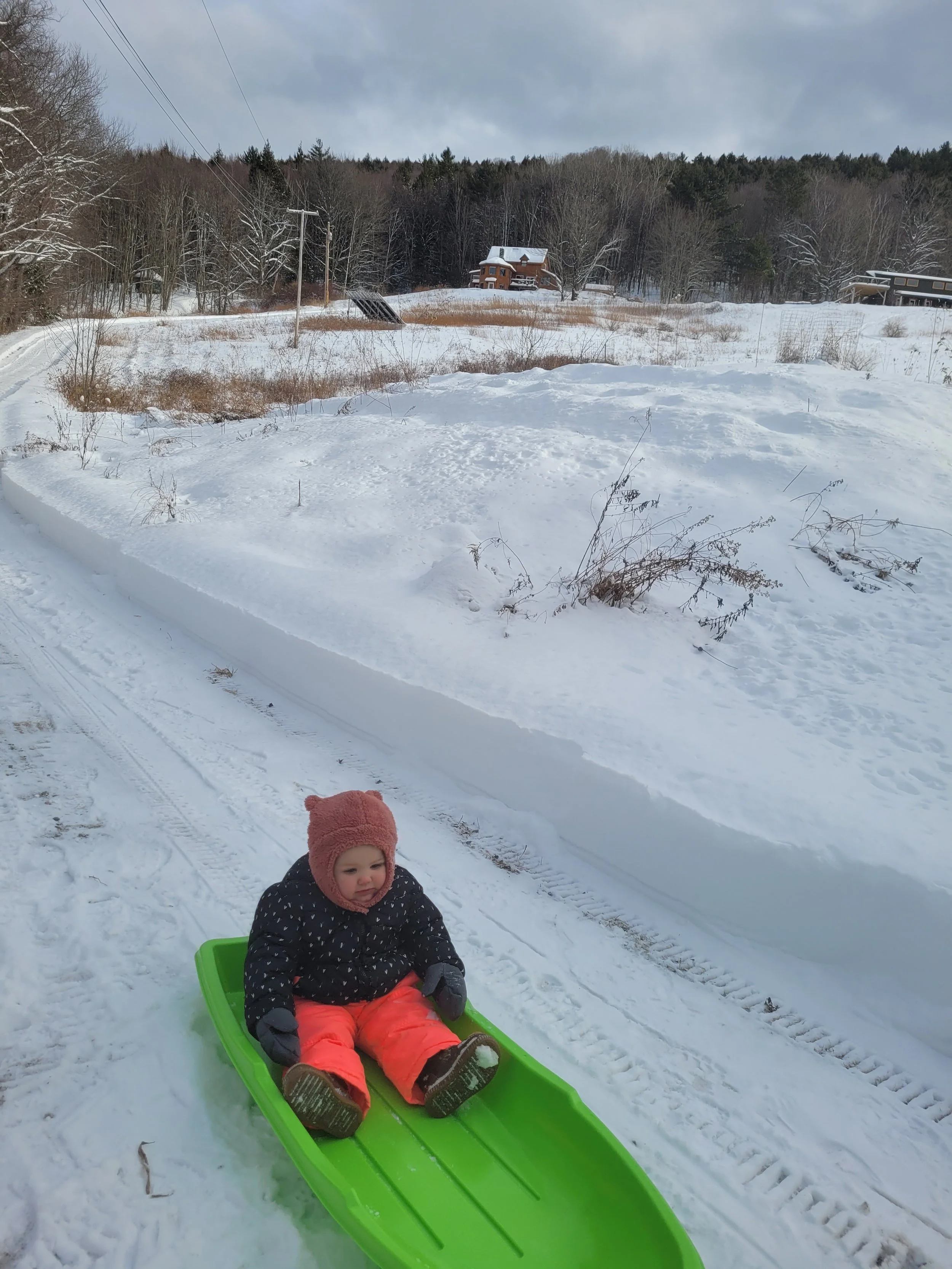
We made it to In Situ the day after the travel advisory lifted in Massachusetts. Our car was extremely unused to temperatures as cold as we were facing and we started the drive with a series of dire warnings [Stabilitrak disabled! ice possible! airbag malfunctioning!], which quietly resolved one by one as the car and the air around it warmed. We followed the plows and the drive was uneventful, slow and bright and clear. We made it to the address Candace had shared and parked next to her vehicle, buried in powder at the bottom of a long, curving drive, and pulled the kids up the hill on a lime-green plastic sled, a lifesaver. At the top Candace welcomed us in to the Art Barn and fed us acorn scones and coffee with maple syrup.
This conversation has been lightly edited for length and clarity. You can find more about In Situ and its stewards at the following places:
Candace & Owen on the porch - Photo failed to develop, likely because it was zero degrees when we took it.
For further reading, see:
Big Town Gallery, Rochester VT
Ro Adler, Philadelphia artist (& Oberlin Storytelling class alum)
Joanna Macy interviewed by Krista Tippett on NPR
Root Division Residency in San Francisco
Macy Chadwick, In Cahoots Residency
Caro Ross, Found and Ground
V: Hi honey. I think you've got it, but I will help. Is this a potion? I think this piece attaches to something littler. Can you find a littler piece? Oh, wait, I figured it out. No, I didn't. You need a connector piece between these two. Keep searching.
V: That was 2018?
C: Yep. And then they were basically just looking for a place while we were starting to meet people and build community otherwise. And then it was kind of a harrowing, long couple years, but then the pandemic hit as well. A couple years later, we ended up losing our housing. We were unhoused at the very beginning of the pandemic, which really sucked. And it was interesting because our villain origin story is that we were kicked out of and evicted from art studios in San Francisco during a second tech bubble nonsense. And that was so frustrating, [laughs] to just be treated like dirt.
V: A radicalizing moment.
C: you know? Oh, I would never do that to artists, right? So that was one of our things, we felt inspired to do the other thing. Do the opposite thing, make space for artists. So then losing our housing at the beginning of the pandemic was a nice reminder that oh, yeah, people who own property can just unhouse you. Can just kick artists out again. So I was pretty mad about that for a long time.
V: I'm still mad about it!
C: It feels less burning now that I'm talking about it five or six years later. At the time, I was very upset, and we ended up taking over a temporary rental in the meadow. You can see from here-- for a friend, my manager at the time, whose job immediately cessated, and then my job stopped. I was teaching yoga, so all the yoga studios closed. We ended up taking over her lease, which was a lot cheaper than our previous rental. So we were suddenly economically more secure, even if it felt scary and awful to have to move all at once.
E: [indistinct Lego questions]
V: I bet there's instructions, a little book that tells how, and it might tell you what piece you need.
C: So we were renting over there in that little meadow just from March or April.
V: But that was a month that was ten hundred months...that was a really long month, a month that was years of life.
C: March was crazy. Actually, March was really nuts for me personally, also because I had just installed and opened my very first solo exhibition in New York City. It was everything. And then my show got shut down, so all my art was trapped in New York, and no one could see it. It was a bummer. What a wild time for everyone, and for me, and for us. But then, because we were renting in that meadow-- we had not been looking in this immediate area for places for the residency. But we looked up the hill, and we ended up coming up here to look, and I was kind of like, this could be it. But at the same time, there was a lot wrong with the property and the house, and there were some vibes--
V: Yeah. I'm really interested in your relationship to commons and commoning. That's part of what I'm investigating with this project, is projects that have a knowledge about and relationship to that concept of commons and commoning, and shared resources. I'm using different language depending on who I'm talking with, but I know that's something that you have as part of the name of your project, so I'd love to hear how you're coming at that concept.
C: Well, I'm just a little anarchist. At different times of my life that's been more brazen or not. I remember identifying with themes of anarchism and self-sovereignty and de-systemization from a very young age, like grade school, and expressing these things and having them be sort of poo-pooed, to put it lightly. Or dismissed. And that didn't deter those values, It irritated me. So I have that in there, deeply. And I have a blue-collar background, and my whole family is probably more conservative than I would be delighted to be ever, but I was raised with a strong sense of the importance of conservation and a certain amount of respect for the environment. So like in eastern Pennsylvania, there's a lot of anti-landfill sentiment. There's a lot of pro-wildlife conservation and small-scale reserve vibes that are not isolated on the lefty side of politics. So even as I was growing up, unaware of my own politic, it felt important to not hurt animals, and to not pollute water and to not litter, right? Just really basic stuff that traditionally wasn't actually political.
So I think because of that, because of those two things, and the air I was breathing and the water I was drinking as a kid, as I've gotten older and become an adult– and I'm turning 40 this year–
V: Congratulations!
C: –which is old. I think at some point I realized how those things are the same thing. And that being part of ecology, being a living being, is sharing life with all other living beings, and that there's a certain kind of inherent acknowledgement of the sovereignty of life, right? So I'm really interested in deep ecology and revitalizing animisms.
I'm coming at those things from a strong feeling of lack and scarcity in the dominant culture that we're living in. So I think commons, to get to your question, the idea of commons, is working towards a utopian idea about how things could and should be. Not with naivete, but knowing that the only way we ever get there is by presuming to act as if we can get there. So I've coined, I'm pretty sure I coined this. I'm a collapse-aware utopian. [laughter].

E: [Lego talk, indistinct]... middle piece,
V: I think you're on the right track.
C Yeah, that one does, they don't attach.
V: That's part of my thesis, is that you need someone to show you, even if you have the instructions and the parts, you need someone to show you [laughter].
C: There were some challenges here. Owen wasn't won over right away. All of our parents were like “do not buy that place,” which was very funny. I mean, none of them had ever tried to buy a house to make a commons, right? So we took that with a grain of salt. I think we were feeling a kind of urgency, in part because of the number of years we had been searching for a place, the feeling of the pandemic, the way that the housing market was starting to respond to second and third home buyers finding ways to escape.
V: We were in upstate New York, and we just drove through there again. Oh, yeah.
C: Yeah. It's so crazy. There’s a lot to say about that. So I think because of all those feelings, there was urgency. We were just like, let's just get it and start, because otherwise we're going to keep looking for the perfect place and not start anything.
V: Famed philosopher Lemony Snicket once said, If you keep waiting until you're ready, you'll be waiting until you're dead.
C: Yeah. So then we got this place, and the pandemic was rolling. We couldn't find any contractors, so poor Owen became our lead contractor. He was just working on the house, which needed a lot of intervention. Invisible intervention, too. Like a rotten sill plate and the roof was rotting. It was stuff that the inspector didn't catch.
So this place is just a big, dusty old horse barn. It's just the hay loft, it’s dark inside, big wasp-covered doors on either end, no stairway. There was a ladder close to where the coffee station is. And then downstairs were all these old horse stalls. I think it had been built in the late 80s to house either horses or sheep, but was only used for that for one or two years, based on the timeline that we understand. The house was only built in the early 80s, not that old of a house, but it was built by one guy. He was a person who built many houses to varying degrees of quality and excellence around the area. And I think he built the barn also a couple of years later, after he had already sold the place.
So he built this place for him and his family to live in, and then they got divorced and they left, and he built this, but then they had sold the place to an older couple who only lived here for a couple years. Then they left, with this huge barn that had been built and barely used, and then it was owned by this guy who was involved in one of the local private schools. He and his family lived here for a long time and owned the property for 25 years. The kids grew up here. So I guess in the last few years of their ownership, the kids were all off to college or starting their young professional lives, they were divorced. Nobody was living here. They were renting this occasionally. As a ski rental house, which makes no sense, because we are 40 minutes from any skiing place. But that's what was going on, which is interesting.
Part of the reason that the house was in somewhat of disrepair was because it hadn't been lived in and taken care of for a long time. And this barn, in theory, had never been really properly lived in and taken care of, except for right at its start. So it wasn't a tear down. Obviously, it was a place that needed some love and attention. But also, I mean, you see the situation.
V: Are there pieces from the original build that are still here, that you still incorporated?
C: Yes, I mean, you can't see anything because it's all drywalled for fire safety and insulation, but the building is still the same building.
Owen: I think there's a few reclaimed–
C: The window sills are all reclaimed. We told our contractors-- we did end up finding some contractors. They were very, what's the word? Sort of traditional or conventional contractors, they weren't, like, greenies. We were looking for a bunch of greenies, like eco-builders, to work with. We actually found one, and then I guess his life kind of fell apart. [laughter] We had been talking with him, and then he just disappeared. So we ended up finding these two local, sort of conventional contractors, and I think that that made certain decisions probably go in ways that we would have otherwise tried to do something more crunchy. But, you know, they knew what they were doing in terms of the conventional stuff. So we ended up with a lot of drywall.
V: I mean, it's beautiful!
C: It is, in a way, beautiful, but it feels like a house. When they were first finishing it, I was like, this is not the Art Barn I was picturing, right? I was picturing a barn, except warm. So that was interesting. There's definitely pieces that were reclaimed. We told them to use as much as they could, and they did do that. If we go down into the workshop space, I can point some things out.
V: I would love that. The parts where I wouldn't be able to know unless you showed me.
C: We were responding to the building that was here, so we wouldn't have built this purpose-built as it is. This is what the building was. And so that informed a lot of decisions too. But we knew we needed a space for us to make work. So our studio is downstairs, where the fire is, and then three-quarters of the building we designed to be this shared space for when we host artists and host workshops and host salons.
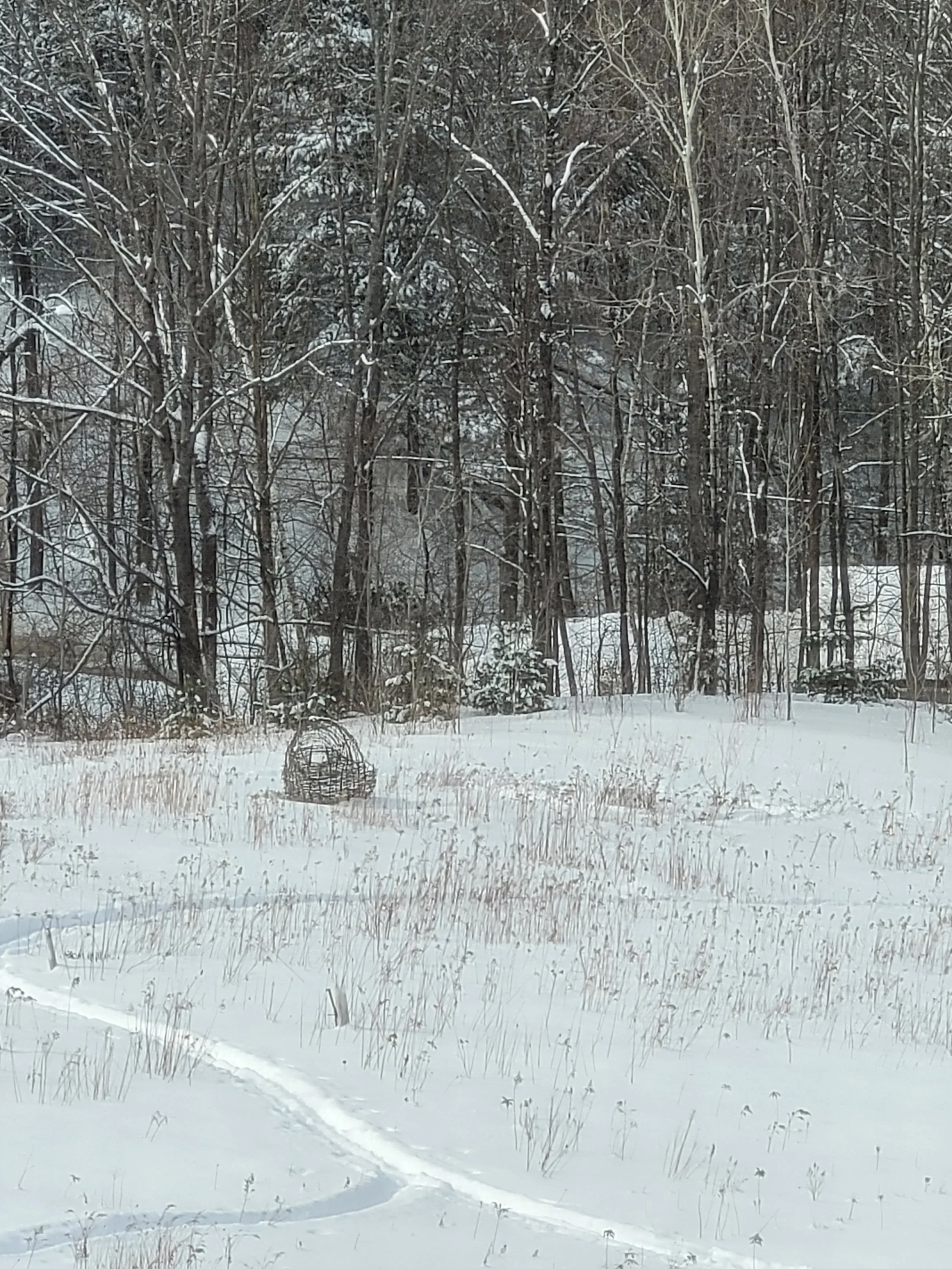
Photo of Yellowfinder from the window of the Art Barn
And there's a really strong need for people to abandon systems that are harming the earth and that are harming humans and that are harming living things. I'm really interested in the rewilding movement. I’m really inspired by Peter Michael Bauer rewilding Portland. There's conservation rewilding as well, which I think can be great. Sometimes it's very human exclusive. It does that thing where humans are separated from nature. So I think there's a lot of people doing a lot of cool things that are creating, not just commons, not just like land that can be shared and resources that can be accessed, but are helping to free up ideas or ideation about what sharing looks like, what what we are doing and what we should be doing or could be doing instead. And I don't want to speak for Owen. I think Owen is very sympathetic to all of those things, but he doesn't usually use as strong of terms as I do. [laughter]. Is that fair?
O: I think that's fair.
V: Where did you grow up?
O: Central Wisconsin.
V: Okay, right. You mentioned Wisconsin. I'm wondering if you could tell me a bit about your art practice, especially as it relates to the environment you're on, or the environment in general.
C: Since starting the residency, three-quarters of my creative output is actually admin-ing and running the residency, which is interesting. So now that the residency exists and is happening, I'm trying to navigate what it is to pull back a little bit, enough of my energy that I can still work on my own creative work. But that being said, the residency was preceded by curatorial and community-building art projects that I did since grad school, so I have a social practice. The residency is part of my social practice, but my studio work, that's mine. The piece above the stairs is "ever-widening grief circle." The title of that is actually a transcript of Joanna Macy talking about ecological grief when she was being interviewed by Krista Tippett on NPR. I was driving somewhere when I was hearing this, it was either a replay or maybe it was the day that she actually was on there. And Joanna Macy passed away last year, which is really hard. She was an important elder. I was driving somewhere and it brought me to tears, just hearing her say these things. Because I experience a lot of grief. I think a lot of the grief I have is eco-grief.
That [piece] was exhibited in the Southern Vermont Art Center in 2021, I had a solo show there. We both did. Owen had a really big one with lots of paintings. So I do a lot of work like that, where I either experience something, or I read something, or there's a conversation. A lot of it's the oral tradition coming through transcript. Some of it is, I'm just reading a book of poetry, a book of essays. Most of these are either deep ecology in nature or ancillary to that. So then I make illuminations. I started doing this in art in graduate school, the idea being that calligraphic illumination is a practice that's reserved for the most important–
V: Yeah. Gosh, I've got a million more questions. But something I'm interested in for this project is thinking about your conceptual project ancestors, or even just places where your project receives resources, in the same way that in an ecosystem there's this resource transfer as trees die and decompose, or animals move in and out. So anything about that story I'm super interested in hearing.
O: Which part?
C: I want to give you a chance to talk if you want. I'm the wordy one.
O: Yep.
C: I feel like we had a lot of institutional ancestors that showed us what not to do. Which is a perfectly effective way, right? [laughter]
V: That can be very powerful!
C: I think about the things that my biological and ethnic, cultural ancestors did that I will not do. It's a powerful way of learning, just to say, not that.
V: Yes. I've got a bit around this of like, mending as refusal, or mending through refusal.
C: I think there's a lot of ancestors that are refusal information. Or antithesis. I think that's real. Because a part of me has a very grandiose idea about what something like In Situ Polyculture Commons can do, or what Sable Art Project can do. Like, you literally want them to change the world, and I want people to see that you can just do that. You can just do that, right? Not because I know the answers, but because I've seen what other orgs, institutions, individuals with power and resources, have done. And I'm like, not that. Coming through the traditional higher education pipeline and art school, there's a lot of-- don't do that. When I got out of art school, I didn't want to make art for ten years. It broke me, in a way, and that's literally by design.
V: You hear that all the time, that's not unique to you.
C: No, I'm not. I'm neither unique nor special. The pedagogy is so messed up, So don't do that, right? [laughter] And then, even in grad school, I eventually found my way back to art making, and wanted to get out of marketing and graphic design as a tool of capitalism, and I wanted to go back to grad school. I wanted the validation and the keys to the gates of the art world Even in grad school, you're like, Oh, nobody has the keys to the gates of the art world, but everybody's gatekeeping. So don't do that! [laugher] I think, all of these don't do thats. It's so annoying. That being said, when we were living in San Francisco, Owen, who was really committed to his studio practice the entire time we were in California–
V: And you're a painter primarily?
O: Yeah.
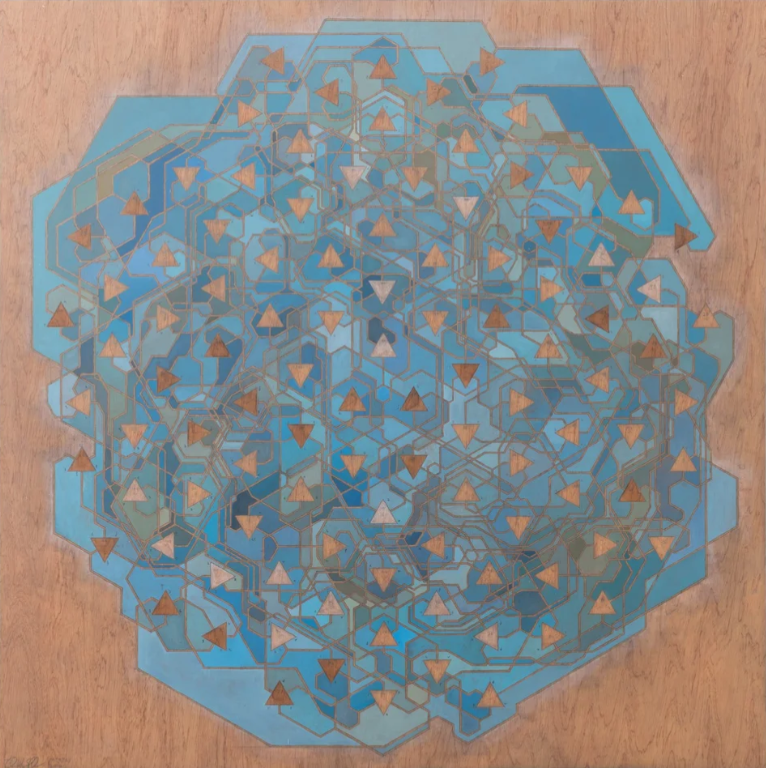
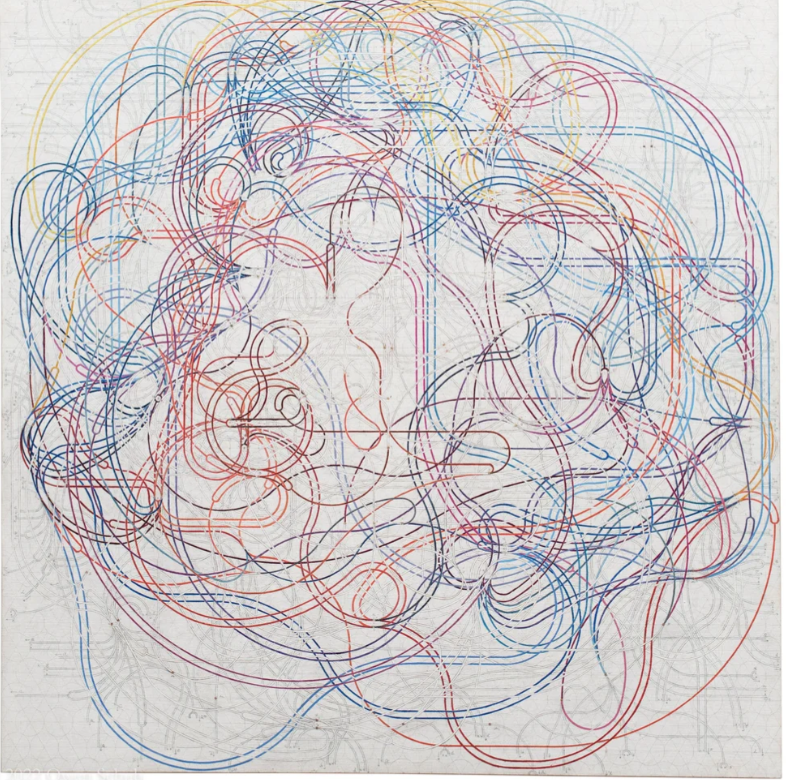
C: He does mathematical painting.
V: Numbers guy, alright.
C: Amazing stuff. He was an emerging artist resident with the Root Division Residency, which is long term, one to three years, subsidized studio access for artists in one of the most expensive cities. With a ton of opportunities for curatorial practice, group shows, providing space for artists to work and exhibit.
O: And they did community work too.
C: And it was sort of a trade. They provided you with subsidized space, community access to these resources. You, the artist, volunteered to teach art to students in underprivileged neighborhoods who don't have art class. Owen taught origami to third graders.
V: Yeah, that's hard! [laughter]
C: Which was awesome. And so they would do art classes with schools. They would do visiting artists talks with schools. Most of it was supplementary educational–
O: Yeah. I mean, some of it was just keeping up the building.
C: Oh, sure, maintenance and work trade. But the work trade was oriented towards supporting the arts outside of the institution. The people who all ran Root Division, and continue to run Root Division are awesome, just like lovely people.
[Baby crying]
V: Baby.
C: Yeah, you bumped your mouth
C: --reserved for the most important texts, and the type of writing that is paramount, or sacred, and a lot of it is reserved for the Abrahamic traditions, or humanistic poetry. So I was carving out a new section for what would be considered vital text. I am hesitant to use the word holy, but something that's sort of elevated in that way, And part of that is because I've always used words, I'm a bit of a wordsmith. I write poetry and lyric essay, and language is really important to me, and design.
When I was in California, I was working as a graphic designer and a chalkboard artist, and so I got well trained in doing hand lettering. So then I decided to learn calligraphy when we got married. I was like, I will learn calligraphy, because I was a chalkboard letterer. Learning calligraphy to do your own invitations is a stupid idea. [laughter] Nobody should do that.
V: It's like an extra challenge.
C: It was so hard, but I got it, you know? And I made something that was almost competent for our wedding invitation. But then I was excited about it. So then suddenly, I was a calligrapher. And there were all these other things. Talk about another world that is a little more conservative than you would want it to be. I went to a calligraphy convention. And I was like, oh, there are only two weirdos here. And I'm one of them. [laughter]. So I've finally found a way to put all the things I care about into one thing…I'm hoping to write more soon, I miss my writing practice, but mostly In Situ has been my creative focus.
V: And how long have you been running your residency? I'd love to get some stats. What number of artists, where do they come from?
C: Oh dear, I don't know.
V: That's also fine. You didn't say you were a numbers guy.
C: [Owen’s] a numbers guy. But also, that's the least interesting part of doing anything is all of the books-- we've just avoided as much as we possibly can get away with avoiding it. We hosted an informal thing in 2022. The Art Barn did not exist yet. This was a barn-barn. Nobody went into it. It was still the pandemic very much, and everybody camped. We had outdoor ink-making stations, and we called it Goldenrod Worship. We invited six artists, including myself, to come here, camp, and make color on the land. Some people got invited who actually have dyeing practices. And we're now much better versed in extracting color from organic substances. I didn't have a lot of experience doing that. I started experimenting with just making basic inks from, like, old coffee when I was in grad school as a sort of waste-not-want-not thing. And I'm still not that interested in the chemistry of color. [laughter] That just isn't my thing. But I love that so many people can get really specific about it. So our first thing ever was this outdoor camping, natural dye and ink making week, and everyone had a great time.
Then in 2023, the Art Barn was being worked on, but I think it was almost done, or it was in progress, but we ended up hosting people anyway. It was a lot of outdoor work, and we had the yurts at that point to host some people. And I think 2024 was our first big, full year. And then last year was actually the year that we had actually put out an open call. We had never done applications. We had always just let it grow organically. So I don't know, how many artists have been here? Maybe 100? Maybe 115 or something.
O: Yeah, I don't know. I'd have to figure out, I'd have to look,
V: I mean, ballpark, a hundred. That's a lot of artists.
C: Well, it's because we don't just do residencies. We do workshops occasionally. We have visiting faculty come and teach. And so we've had a couple dozen people come for those sorts of things as well. And then the residencies, people are staying and working and being collaborative. Or resting. I think it's probably closer to 60 or 70 at this point.
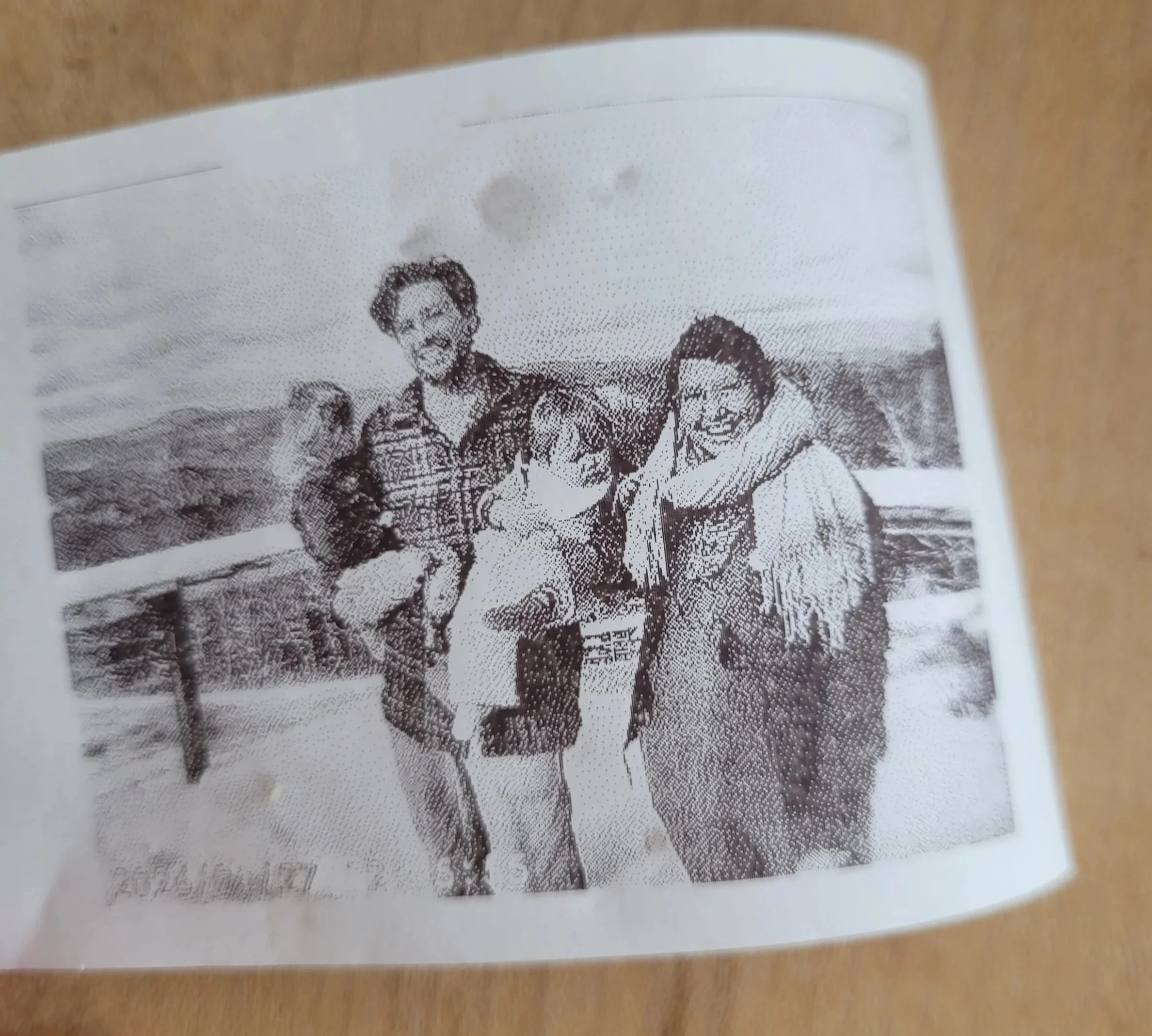
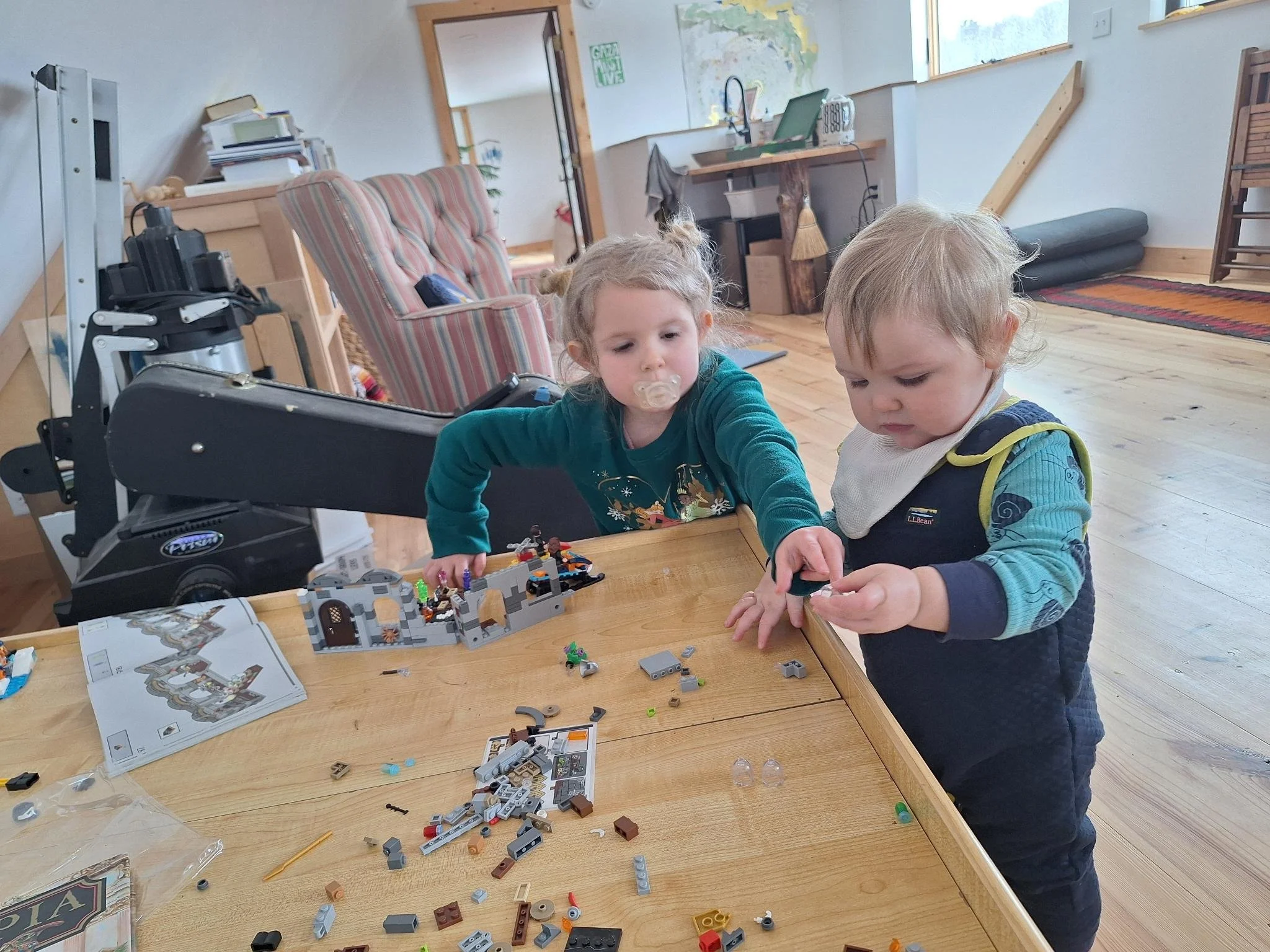
Collaborators. Photo by Troy Spindler-Fox,
V: I did just see, looking through your website on the way up, that my friend Ro Adler was here. And I haven't seen Ro in a while, but we went to school together.
C: You can see Ro's installation!
V: I really--Yellowfinder? Oh my gosh.
C: It's right there. It's the giant basket–
V: Oh yeah! I taught a storytelling class in undergrad and Ro was in that class.
C: Did you go to school with Ro? Oh, cool. Oh yeah, I was at Sable with Ro's partner Emerald. Which is really funny.
V: Oh! Small world.
C: So I'd never met Ro until this summer, but we had been in community apart for a while. Yeah, Ro is super cool. I loved having them here.
V: Super cool.
C: I'm excited that Yellowfinder is doing very well, hoping that they will come back up sometime and check in on it, see if they want to add to it.
V: And what years were those that you were in San Francisco? I was there in 2013 and 2014.
C: Oh cool. We overlapped. We were there from 2008 to the end of 2016.
V: Wow. I was living in Marin Headlands and doing environmental place-based education for third, fourth, fifth and sixth graders.: It was great, and it was also such a terrible drought year. It was pretty brutal. And it was just a year of really widening inequality.
C: Yeah, that was the year we got evicted from our studio. One of those years.
V: That makes sense. Yeah, so bad. I was working as an AmeriCorps fellow, basically. And that was the first of the long government shutdowns in which we weren't allowed to work. And there were all these things about, well, you should do it anyway for the kids, you know?
C: Do it anyway. Yeah, you could pay me anyway, right?
V: Yeah. It was a time. I mean, that was also a radicalizing time for me, as a baby anarchist who already had these ideas, watching who was able to float during that time and stay working in national parks, doing these awesome, cool jobs, and who wasn't.
V: So project ancestors, and also your project cousins. Who are you in a network with?
C: Well, I would say Root Division was galvanizing in a very good way. Root Division knows what they're doing. They are functional within the incredibly dysfunctional arts nonprofit world. They're riding waves, they're helping artists, and you see an enormous amount of alumni support for the organization, people who have been through there. I feel very like an honorary Root Division alum, because I was always there when [Owen] was at a studio. One of our board members, Christopher Reiger, was also an artist in residence at Root Division at the time, and one of our founding board members, Nathan Suter, was with us on the board for four years, and he passed away last year.
V: I'm so sorry.
C: Really devastating. He was an amazing human being. He founded Root Division, so we got connected with him– he was here in Vermont. But he had started that organization with colleagues years ago, and then had helped to hand it off to the leadership that was there when we were part of the community. But he and Owen also went to the same college, Haverford College in Philadelphia, which is kind of a fancy liberal arts institution, but also has a lot of really important ethical underpinning.
V: They're Quakers, right? Very cool.
C: Which was part of the reason Owen was interested in going there.
T: I almost went there. There and Oberlin were my top two.
C: Nice. I didn't even know places like that existed. I was the first person in my family to go to school. So, like, I learned about places like Haverford college, Cooper Union, which used to be free, way after. My family didn't even know these places and types of things existed.
O: Your guidance counselor sucked, too.
C: Yeah. I did have a garden counselor in 11th grade that told me I was too smart to go to art school. [laughter]
V: Love that vote of confidence.
C: I fired them. I literally was like, I'm gonna get a different guidance counselor. You're not my guidance counselor anymore.
V: Love that. Yes.
C: So Root Division, I think, is a good ancestor. They inspired us. They were making space for artists. They were figuring out ways to function within a dysfunctional system. They were like working as a big, small nonprofit, without losing their humanity. They were doing all those things, and that was really inspiring. I think we were inspired ideologically, by places like Black Mountain College.
V: Yeah!
C: You know, the idea that the academy art school isn't doing very well. Let's just go to the mountains and make weird stuff together, right? Let's just do it over here and not worry about it. So there's that, although we're not intimately familiar with Black Mountain College, or we don't have any direct connection.
V: I bet there's one there, though, if you do the family tree. [Laughter].
O: Probably by way of San Francisco, sure. Ruth Asawa or something. Because she was so involved in everything,
C: Yep. Who's in our network, who's in our community? We met Otto and Jess and Sable right when we moved here, and we kept them in our satellite. We are colleagues with them, super proud and in admiration of what they do and how they do it. I love that. Otto, you know, became a world class model, [laughter], randomly, out of dance school, and then used all of his modeling money to start a little cute queer anarchist project in his hometown hills, in Central Vermont.
V: It is so iconic. [laughter]
C: I love that origin story. Well, and we wouldn't have been able to do any of this without the familial support of Owen's family. Owen's family invested in our ability to buy land and then become the land stewards and then renovate this place and then invite the artists here. We wouldn't have been able to do it without a patron. Owen's folks were really interesting. They really love art. Owen's mom is an artist. They love art, and they are really supportive of artists, and I think they are really happy that we run an art residency. They love that, but I think they also don't understand it.
O: Yeah, I would say so.
C: In a very different way from people in my family, who are like, for the 80th time, 'what's an art residency? We just don't get it.' Owen's folks are not quite like that, but I think they're very happy that we are running an artist residency and that we are supporting artists, and I think that we are supporting artists in ways that they can't totally comprehend or understand, but that doesn't make them reduce their support. Would you say that's a fair way of framing it?
O: I think that's fair, Yeah. Because I think the reality of trying to make it as an artist is quite a bit different than the last time they checked in on that. And residencies are a thing now that you're-- not expected to do, but that are really beneficial to building your community and, quote, unquote, career,.
C: Yeah, I feel pressure to build the CV, You know, I feel it. And I did a bunch of residencies before we started our residency, I was like, I've got to apply for some residencies. And I did.
V: Where'd you go?
C: I did the Vermont Studio Center. I did the Arctic Circle residence. I did a residency, it was really weird, a traveling residency with a graphic design studio from the Midwest, and we went to Norway. Part of the reason I applied is that they were going to Norway, and on some of their residencies they would do these little group shows. I was totally in the mode right after grad school of, understand what residencies are, so you can build your own but also build your CV and get your opportunities in. I was doing that. You're cutting your teeth, you're understanding things. So I joined a cooperative artist-run gallery in New York, which I showed and curated with for six years. I applied to these residencies-- Light Gray Art Lab was the residency that was in Norway.
Photo by Elinor Spindler-Fox
C: It's validating to have somebody be interested in the project at all, in the way that you are asking questions. Thank you.
V: When you said that about this shelter that you're operating under, of putting ecological art first– It feels like it's weird, how rare it is.
C: It's infuriating, actually, how rare it is. It's not good. You sort of see the divorce from reality that the art world, which I'm going to keep putting in quotes, because the art world is a really closed off gatekeeper-y messed up, dysfunctional part of society, and it purposefully excludes a lot of activism until that activism looks good in a frame. It purposefully looks away from the aesthetics of resistance against capitalism, against fascism, against ecocide. As an environmental artist, as somebody who identifies as one, I felt like a weird, ugly, redheaded stepchild, kind of niche artist, or– I didn't actually feel that way. I've never felt that way. I'm very confident. [laughter]. I was made to think that, because I was an environmental artist, that the environmental artists were sort of in this weird stepchild category,
V: I have seen a call for submissions that explicitly said, like, no decomposing material and no dirt. And I was like, well–
C: What are you even doing?
V: If you don't want anything cool or good, that's fine.
C: Yeah. Thank you so much. That's cool
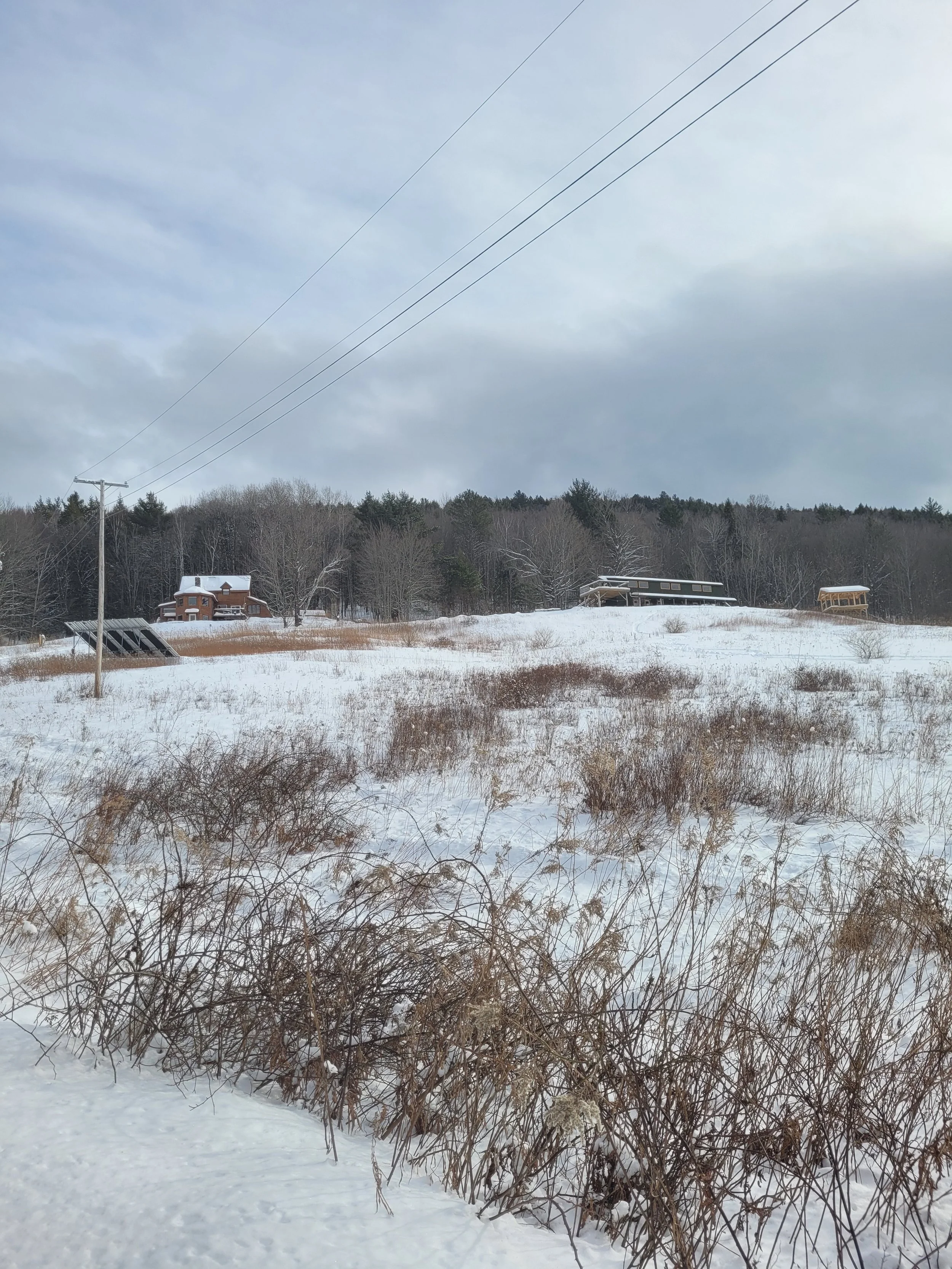
[Baby shouting]
C: Do you want crayons and stuff? Or blocks are better?
Troy Spindler-Fox: We've got markers.
V: And you're a hungry guy, I'll give you more milk.
C: Hungry guy!
V: Yeah, Baby Micah is in their growth era, I think. [laughter]
C: 18-year growth era.
V: Yeah. [laughter]. Drink your milk.
E: I have--I have an action figure that I bringed here, my favorite, the other action figures that I have are still at home because I didn't want to bring them and they were too big. And they're from Troy's childhood.
TSF: Yeah. Who did you bring?
C: Heritage.
E: Googa!
T: It's Princess Leia.
E: [inaudible question]
V: Okay, we just have to be prepared to put them back how they belong.
C: Exciting. Oh, the Color Game. That one's really interesting, because the whole point is to get people to guess the color that you're describing.
O: But you can only use one word.
C: You just sort of triangulate them to the color.
V: Cool.
C: It pulls on the emotional and nostalgic, and obviously, if you play it with your very, very best friend from childhood, or your sister, you're gonna win. You know, you have these sort of secret color languages. Anyway, guess the hue. What's the hue? What is it called?
O: It's not Guess Hue, but it could be.
V: Guess Hue! Punch up.
C: So I did the Arctic Circle residency, where I met some amazing people. Had a great time. We ended up co-curating a show, co-editing a journal about the artwork that was made in response to places like Svalbard. Some of these residences are incredibly expensive. People basically get in and then they immediately start applying for funding, grants, running Kickstarter programs, doing limited edition printmaking to raise money to go. So I definitely paid for some residencies. And when I went to the Vermont Studio Center, I was offered a scholarship or fellowship that actually made it affordable to go. And then I also did work trade, I taught yoga. So I paid almost nothing to be there for a whole month, and I thought that was fantastic. But going there without those resources is very difficult, very expensive. That goes back to that whole idea of, what do you not do? Make it really expensive.
V: And then there's that trade-off too, of what you could be doing instead.
C: So then I did a few other residencies since. I went to a printmaking residency in Petaluma, California, In Cahoots. In Cahoots is really cool. It's also small, privately run like not-a-nonprofit. The woman who runs it, Macy Chadwick, was a professor of art in the Bay Area for many years, and then was like, this is unsustainable. So she retreated to the country with all of her letterpress equipment and etching presses, and started this printmaking and bookmaking oriented residency in Petaluma. One of our board members, Christopher, lives in California still. He told me about it, so we ended up going, and he got to come, and it was so fun. It was nice to be back in California. I made so many prints. That was really nice, because that was the first residency I did since starting In Situ, and I had a week to focus on my own practice. I made so much. I was in the studio sixteen hours a day.
V: You're like, concentrated.
C: I was barely sleeping. And it was interesting, because they do self catering, which is what we do. You know, I'm not trying to run an inn. We always do a welcome meal. So I would get up, I would make my breakfast, I'd have my coffee, I would go to studio. I would go for a walk, and I would go to studios. It was so good to be in that mode again. In Cahoots also costs money, there's a weekly fee, but it's pretty manageable, and they do have some scholarships. I think what they're doing is good. I'm happy, I would go back. And I've told people that it would be a good thing to go if they have a printmaking or bookmaking practice. It's a very similar scale, between four and six artists at a time. Everyone has shared studio space, and with printmaking, that makes more sense.
Were there any residencies I did that--I I didn't apply to any that I wouldn't have wanted to do. There is sort of this cachet, the desire to go to MacDowell, or some of these big ones.
V: I don't think I know–
C: It's a big one. they used to be called MacDowell Colony. They've since decolonized their nomenclature. Now it's just MacDowell, it's in New Hampshire. It is actually one of these big old hulking mansions or estates that have been transformed into an arts place. But they are well known because they are free. They cost nothing. They provide you with a small stipend. They feed you so you really are taken care of. Vermont Studio Center, they do as well, so you don't have to do a lot of the normal everyday things. You're just there to make art. There's something really powerful about that. But I think like, to speak plainly of Vermont Studio Center– they function like a big nonprofit, right? Huge fundraising engine. They're resourcing themselves from the artists who are coming. Not all artists are guaranteed financial aid. It's very costly. Owen got in to Vermont Studio Center with a scholarship, but it didn't cover the whole thing. We were living across the country at the time. We were looking at it, and we were like, are you gonna pay $5,000 to go work on your paintings in Vermont for two weeks? It was a lot.
O: Yeah, I think with the travel on top of everything, it was crazy.
C: We were like, this doesn't make any sense. You just didn't go. But then he did end up going to Vermont Week, and Vermont Week is one of the things that Vermont Studio Center does that I think is amazing. Like every single year, Vermont artists are invited in for free residencies, to work in community with each other, directly supported and aided by the institution. They do some good stuff, but there's some challenges.
V: I grew up in Gatlinburg, where Arrowmont School is. And, like, I think it's wonderful. I knew what an artist residency was. And there is also a dynamic of sustaining the organization for the artists, or sustaining it by, like, milking those artists. [laughter]. And that, you know, changes over time.
C: Right? We didn't want to milk artists. We don't want to do that. Right now we run our residency on a sliding scale model, and that's just to cover stocking the kitchen and some stuff around the barn, and then whatever we have over we try to use directly stipends for artists who need more resources. So we're not ever giving anybody a bill. And actually, people are a little weirded out by that. They're like, what do I owe you? People will show up, and then we'll get out of their car, and the first thing they say is, 'who do I write the check to?', they're so stressed about paying. I don't want people to be stressed about paying. We do think that if you have resources, you should contribute, but we don't think that an organization should make its buck and its bottom line off of the backs of the people that it's there to support.
So it's kind of a funny thing. If people do have resources, they should contribute in a way, but at the same time, I think more artists should be paid for their work and supported more generously by more organizations. Most of them don't do that.
V: Who else is around you that I should talk to on my little journey?
C: Have you heard of the Piney Wood Atlas?
V: Yes! I saw Piney Wood Atlas when I was at Sable Project, and I was like, I love this. I want to do something like that. But I am not doing just residencies– I've made the bounds of my investigation into radical projects that are based on land and that are doing something to create livable futures.
C: Okay, yeah, that's different. Oh, that is really interesting, because most arts organizations don't give a flying fork about ecology.
V: Yes.
C: That's so weird.
V: It's so weird!
C: This is something-- so when we were designing the residency, it's our project, but I'm definitely, like, the steamroller of what are we doing, and why. I'm the one that designs all the things, and then we talk about it. Hardly any art organizations do jack-all in terms of ecology, or in terms of understanding relationality and the environment. They, some of them have these dumb environmentalism statements, or they're like, well, the building is LEED certified,
V: We've got compostable forks in the dining hall.
C: Right. Which, I love me a compostable fork when I don't have a fork. [laughter] That's good. So when we were doing ours, because deep ecology and ecological belonging and relational being is really important to me. I was like, that's what our thing is going to be. We're going to organize around that principle, not because we only want to be for our environmental artists, but because it's very clear that everyone is an environmental artist, whether you choose to work in that niche or not. Right? Like everybody is making their creative practice happen in a specific place and time with specific relational networks, resourced and/or antagonized by other beings and systems. So it's very stupid to just do the white box thing and to do the conceptual art, or like post- post-modern thing, where you're just like, nothing matters but the concept right? Like, it's this mind over matter-- So we're very against that.
V: Yeah, and it was goofy to do that a hundred years ago. It's really goofy to do that now. [Laughter]
C: Yes, now. Yeah, so that was just sort of, I was like, we're just gonna put that in there, and we're just gonna go for it, and we're just gonna support artists and make space for artists, but we're going to do it with this sort of-- that is the shelter under which we are producing space and programming for artists and helping people to see what that is.
Part of it is that we're learning. We both lived in cities for a long time. We both grew up in rural suburbs, very rural. Emphasis on that. We had a compost pile in the back, but what else were you doing? I think we encourage people to get off polymer-based art supplies when they're here. We don't get a ton of resistance with that. People aren't like, what do you mean I can't use my acrylic paint? And we don't say that they can't. We just say, learn more about what that is and why. Or place-based color, we’re very interested in how people can develop a relationship with a place-based color. Encouraging people to make art outside, encouraging people to have an indoor-outdoor practice, which is super easy in Vermont in the summer.
I think we've really come into re-skilling and helping people of the creative orientation to have a direct relationship with the materials, as opposed to being the recipient of post-industrial materials. And I just think most art organizations and most artists don't think about this, and aren't trained to think about this, and aren't asked to think about this. And you have to be sort of put in a position to think about this. And then once you've thought about it, you can't unthink it. And then you have to change what you're doing. Or not, you know, but at least then have to validate to yourself why it is you're either continuing to do this or not doing this at all. Whenever we have our friend Caro Ross, who's a British woman, amazing person, so cool, she comes to teach workshops here, we literally know each other from Instagram
V: I love that.
C: Back in the good old days when you just met weirdos on Instagram.
V: Before it was like you have to poison yourself every time you open it, take psychic damage.
C: It hurts, yeah? Psychic damage. A lot of that, drinking mana potions, looking at your Instagram.
V: We take turns in our family, like my sister will be on Instagram, taking the psychic damage, reviving herself and bringing us back little scraps.
C: Like, this is what you need to know. Found this really nice thing., I know Owen’s worked really hard to have his algorithm be really cute animal oriented, but it's been messed up with AI, really,
V: Oh yeah, they've devastated the cute animal community.
C: The cute animal algorithm is poisoned. It's not good.
C: So I met Caro on Instagram. She used to be a professional musician in a cool band. Traveled all over the world, but then she became a natural materials maker and an artist. She teaches Tai Chi. She's so cool. So she comes here and she teaches watercolor making, pastel making, earth pigment making. She's all about found material. Find and grind. So her name is "found and ground," that's her thing that she does. I'll show you her book downstairs.
So when people are here learning how to make watercolor with Caro, we always tell them, the point of this is not that you throw away all of your other paint. Don't do that! You have it. It's very good. You're not like [whoosh], this is not the influencer vibe of like, I'm gonna redesign my kitchen, throw away everything, and then get a nice, clean aesthetic. That's not the point. Like, purity isn't the point. Caro always says that, I'm paraphrasing her. So she uses old contact lens plastic containers, mussel shells, everything. You know, anything that you can put watercolor in. Acorn caps.
V: I love post-apocalyptic practice.
C: Yeah, it's informed by reality. We always tell people, just make this one color and then, look, you made that color. You have a relationship with it. You know where it came from. You also understand the labor that went into making it. That is going to change the way that you work with the rest of your palette, right? And still, I'm not going to give up using my beautiful traditional Chinese malachite. It's the most gorgeous green. I'm going to still get it from that little watercolor maker, and I'm going to use it right next to my ground brick that I found in the woods. There's something about that. So it's like seeding awareness, seeding relationships, seeding material knowledge. In with just helping to open up the view.
Because to me, I don't think I'm wrong about this-- the art, the perspective of artists, and artist makers and the art world has gotten incredibly myopic. There's this really problematic over-emphasis on identitarian art making and hyper-conceptualization of everything, where nothing is supposed to belong anywhere. It's all supposed to be like, transportable to any other neutral white cube. Yeah.
T: Do people leave a lot of art here when they leave?
C: Yeah, some people do. We actually started encouraging it. We had people who were just like, here! And they left a piece. And then we were like, well, if you feel inspired to leave us a little thing, we want to build the art collection of things that have been made here. And then people do, which is neat. This was left, there's a beautiful little ceramic window, that was a thing.
V: Elinor, I could use your help taking some pictures while we're here, either with your camera or with the black camera.
T: Do you have any other kind of record, like a yearbook of who's been here?
C: I wish I had done that. I wish I had had the foresight to do something that organized the first year that we started, because I wasn't organized yet. So now we're like, people can leave us a piece, and we try to hang them up around to inspire others. We have a little recipe book in the guest kitchen where people can cook. Some people do that to greater or lesser effect.
T: Because, speaking of Arrowmont, we met the old director, Bill Griffith, and went to his house, and he started the artist in residence program there [V: In the 90s], and he had this book with a picture of everyone in it. But more importantly, he had a piece of art that he had traded with everybody. He was a potter, and he could trade art.
C: That's amazing. That's so cool.
T: His whole house was decked out. Vic's grandma, who's a weaver, had a similar experience, before her house burned down.
C: Oh, no.
T: And had this network of relationships through the art that was just, like, around.
V: Yeah, as an artist, working where she was in East Tennessee, there's a really powerful craft tradition, and also it's a place where people come on vacation and want a five dollar T-shirt. We're at this real intersection of, I feel like Gatlinburg is a nexus where different worlds touch. Like, my mom always said Gatlinburg is possessed by a demon of consumerism. And she was kind of right?
C: She sounds awesome.
V: She's--powerful. Awesome is in the, like, trembling with fear way, yeah. But so there's this little tiny craft school that is maintaining 100 years of craft tradition. And then it's right behind a go-kart place called Cooters. And those things are touching each other in Gatlinburg. My grandma is an incredibly talented weaver, she makes incredibly beautiful sculptures, and all of her friends are similarly talented artists that have practiced their craft, and they can't sell what they make for what it's worth. There's just such a disconnect. But they trade with each other, so they each live in these magnificent–
C: Opulent–
V: Yes, exactly, just where every single object is has such incredible terroir and the knowledge of your person who made it.
C: Oh yeah, art terroir! I'm a wine girl. I really like that.
V: Yeah, of course. And that was really informative for me, coming up in that world.
E: [indiscernable markers question]
C: That's a methodology problem. But you'll either embrace it or get over it.
E: I couldn't find the cap, so I might just--
V: They keep getting dropped on the floor.
T: Micah's ready to get into something.
V: Yeah, we might not have too much more time here with you.
C: Yeah, that's how that happens. We understand.
V: But I might have some follow-ups and, before we go, there's another part of my project where I'm just trying to support places like this in talking about the information that you hold, that you would like to get carried to someone else. What do you want people to know about what you're doing in place? Or how could you be a little more supported in that face-to-face knowledge transmission, or documentation or record? What's the thread that you would like to have held and carried beyond yourself?,
C: Everybody should be doing this. Like, more people should be doing this. We have a set of tenets that we came up with. One of them is collaboration and cooperation, not competition. That's very antithetical to the way that the art world works. Everything in art world, which is a fictitious entity amongst other fictitious entities, is all about which artists got the prize, all the artists that didn't, which artists got the opportunity, and all the artists that didn't. So there's this scarcity thing, which is true, because there's not enough resources for artists, right? Let’s not pretend that there's abundance when there's not, but anybody can make space for culture and for creative work. Sometimes that's just making space for you to reclaim human making practices in your own life. But you can also, anyone can open their private space to commons. Anyone can do that. You can allow the neighborhood children to walk through your garden. Anyone can and should be doing these things. So there's this pressure for growth that happens with people who start doing the thing, like, what's your next project? Like, are you going to build another Art Farm?
V: Expand, yeah.
C: Expand! And we’re like, well, no, because we're already at capacity and it's just the two of us, and we have no interest in exploiting a young person for free labor, right?
V: Inconceivable, that you don't want that.
C: So the only way that this kind of thing can grow is in a sustainable way, which is padded by having other people also do it. And so what I want to take away from In Situ to be that, wow, that's both very simple and it's not a really complicated thing, and it's also really impactful and kind of a big deal, because you don't see that sort of thing very often, that mandate of generosity and solidarity. And I just want more people to be inspired by that and to also do it, and it will look differently in other places. That's the anarchism, right? It will manifest in an appropriate way in the other places. But more people should be directly supporting artists, more people should be sharing their private wealth in a way that helps to support public abundance. What else? Copycat us.
O: Yeah. You don't have to do everything we do either.
In Situ Polyculture Commons
Candace Jensen and Owen Schuh
Westminster, VT - January 27th
Vic Spindler-Fox: Tell me again the name of the gallery through which you met Otto [of the Sable Project].
Candace Jensen: Big Town gallery in Rochester, Vermont, [the owner, Anni] is a really wonderful person. They host Bread and Puppet, a sort of traveling circus--
VSF: Yeah! That's our Northwest apex we're hoping to reach.
CJ: Well, Bread and Puppet is obviously amazing. She directed us to Otto. We met Otto in 2018, walked around in the snow with him for a while, and then we just tried to stay in touch. And then they invited me to be a guest artist for a long weekend in 2019, which was really fun. I was there for four days, and it was lovely. And then I've told many other people to apply. We've stayed in touch, and we do end up having kind of a fun Venn diagram of humans that are that have done both residencies.
V: What I'm interested in are projects that are cousins to each other, that have similar influence or values or processes, that then are part of these formal and informal networks. Maybe you could tell me a little more about how you got started.
C: We moved here in 2018. We were in Philadelphia for a couple years, and we had been in the San Francisco Bay Area for almost ten years prior to that. So we were sort of de-urbanizing and looking for more rural life, but also we knew we wanted to start a residency. We knew we wanted to start an artist community sometime. So we were renting in Putney, Vermont, one of the things we found on Craigslist, and then we were just going around and looking at properties. We knew we were trying to invest in a place, get into land stewardship, and ground. And then our idea was that it had to have some kind of infrastructure that we could revive or restore or shift and revitalize through art and community. That turns out to have been a very silly idea. It was very costly to renovate this barn, [laughter] as opposed to just building something for the purpose. But we didn't break new ground, which is what we wanted at the time. That felt important.