BALE (Building a Local Economy) Commons
description goes here
This conversation has been lightly edited for length and clarity. You can find BALE online at https://www.balevt.org/.
For follow-up reading, see:
Center for Agricultural Economy in Hardwick
Vermont Coalition Against Factory Farms- contact at VCAFF@proton.me
Sherri Mitchell, writer and teacher - link
Earl Hatley, Ottauquechee Water Protectors Association
C: And so what's the output of this? What do you, what are we gonna get?
V: Yeah, great. I'm hoping to make a chapbook
C: Or what is the community going to get? [laughter]
V: I'm hoping to make a chapbook, bigger than a zine, smaller than a formal print book. With the history of some of these projects, I'm hoping I can do a deep dive into two or three and then sort of catalog entries. I don't know, I'm still thinking about it, but a way of mapping and showing the network in this region, and how it's interconnected. And especially I'm thinking about the idea of project ancestry, that if you have a project that inspired one thing, and then another thing, and then that project decomposes, those two projects are still related through this idea of shared ancestry. So I'm hoping we can show some of that network and just make visible that I think there's kind of a movement happening, or that people are connected in ways that may not be visible if you're just googling them, but that there are these ways that groups are interconnected and can share resources, and that we can support that connection and build it and make it stronger. That's kind of my hypothesis, and if I validate it with these groups, I'll make a chapbook, and everyone will get to have a copy. I'm hoping to do a limited print run, but at least we'll have digital versions of all those things.
C: Another question, where do you live? What's your locale?
V: Yeah, I'm currently based in Pittsburgh, Pennsylvania. I've been there for about a year and a half. I'm from eastern Tennessee. My family's been there since white settlers first said there was a town there, and I'd been living there when my kids were really little, but I wanted to have another kid, and I wanted to move to a place that had hospitals and schools and museums, and my in-laws are in Pittsburgh, so I've been there. We've got a house, and we're trying to work to make that our home in a new environment, very different from what I'm used to, but I'm really loving it. And Pittsburgh also feels like a hub for many different things. It's on the edge of so many different geological– and it's the rust belt, and it's Appalachia, and you're right under the Midwest, it's at the edge of a lot of environments, and I think are really fun. So that's where I am.
C: Okay, one more. [laughter] So how are you connected to here?
V: Yes, great. So in this FLOAT pilot project, I spoke with Mollie from Rural Vermont, and she was also one of the members who was doing this participatory budgeting. And when I mentioned this idea I had of wanting to talk to groups on the ground, that are doing local work, she mentioned that I should speak with y'all, and then Grace Gershuny also said that you are a group I shouldn't get in touch with. And that's, you know, when two people from different places say, go here. I'm taking that as a big green light.
C: I'm laughing because of the connection. I mean, Grace and Mollie, who are connected, and I'm connected a long time with both of them. Okay, enough quizzing you.
V: You know, I loved that. Thank you. Where do we start? Yeah, where to begin?
E: Yeah. I think we begin a little bit with where we are right now and then deep dive on the history. We do have a lot of projects. We are very multifocal, and also I consider us to be in a transitional space. I officially stepped into Chris's position last April, so it's been less than a year. And so we're deeply collaborating, and we're both kind of finding our way into different, new roles in the organization, while the organization is also doing a little bit of identity shifting, maybe, or re-articulating.
So I think we're in a very liminal and transitional, but also extremely active place, in which some voices say that we need to focus, and other voices say, No, we don't. [laughter]. We are a hub with many spokes. So right now, one of the things that's occupying a lot of our attention is the project that we call the Resistance Hub. And Chris and our dear friend Fran Miller, who also works in the same department at the law school with Bella, are co- facilitating. And that's our community organizing and political resistance project, and it's just really front and center right now, in response to what's happening in our times, in our world.
And I feel like a lot of our identity-searching is happening through that, as we're trying to define, who are we as a hub? What are our core principles? What are the things that bind us together, and what kind of bonds do we have? Because we're not an organization, exactly. We're, right now, a group of community members who are loosely agreeing to meet twice a month and plan actions together and we're discovering how to organize ourselves.
So that's a lot of what is up right now, and that has ended up being a vehicle to attract more people to join us in mutual aid and food access programs. So some members who started coming in to the Resistance Hubs, who got called in through like, we're going to join this national Indivisible rally, and we're going to put on our own version of that rally on the green, on No Kings Day, or on Hands Off day, or whatever it is, and then people coming and getting involved in thinking about what do. What do I want to do? What is my form of local activism? And deciding I want to help feed our neighbors. I want to try to plug some of the gaps that are widening in food access, and so I think that's emerging as the Resistance Hub is helping us amplify that work that's already been something that BALE has been doing.
And then, sort of separately, last year we decided to revive the Royalton Farmers Market, which had fizzled out during the pandemic, after kind of a long process of dwindling from a pretty vibrant market maybe 20 years. It was founded about 20 years ago, 25 years ago.
C: Yeah, before I came here.
E: It had really dwindled down, and then finally died out. And we brought that back last year as a project that BALE sponsored and managed. We managed the market and didn't charge vendor fees, and programmed music and kids activities and different kinds of cultural content to have free gathering space and cultural programming on the Green. That also put people in contact with local food producers and artisans and craft makers and stuff. So that's something we just sort of did on a whim last year, and then this just got a grant to continue. And so now we're thinking about, how can we make that a really sustainable and sustained project, and how does it relate to our community organizing work?
So those are two things that are top of mind for me. There's so many different spokes, and we are also holding this space as a collective resource for our community. So anybody in the community can reserve the space and use it by donation. There are multiple practitioners who have their offerings through here. Like, there's a free meditation group, there's yoga classes, there's a music jam. And there's lots of programming that Chris is involved in putting on at the law school that's co-sponsored by BALE that's around environmental activism. There's just a lot of a lot of different things.
V: Where are you from?
E: I grew up in Brooklyn, New York, and my grandparents have lived in South Royalton since the 60’s, and so I grew up spending all my school breaks here, and I live in what was their house, which was less than a mile outside of downtown, on a former dairy farm.
I think at first I was definitely drawn back here by that piece of land, and a very deep spiritual and deeply felt, loving connection that I have with that piece of land that I feel like I really inherited through my grandmother. And then in moving here, my partner and I were immediately drawn into this space and BALE, and curious about what it was, and just excited about the idea of there being a commons in town, and super excited once we met Chris and found out some of the things that were happening here. And then over time living here, I have become increasingly interested in and drawn to our village, and-- it's not technically a downtown, but, you know, the idea of our village as an organizing space for us as a rural community, and the resources that we share and tend to here, and I think that's like a lot of what BALE is focused on.
It's making this a vibrant-- culturally, intellectually, spiritually, economically vibrant village center for our rural community.
V: I think you've got a great downtown. [laughter]
E: We do compared to a lot, and we're struggling as well, yeah.
V: What year was that? When you were arriving here and finding out about–
E: 2017.
C: And now the eyes turn towards me. [laughter]
B: Yes. Give us the scoop.
V: Yeah, I'd love to hear the origin story.
C: Well, sort of my personal origin story is, I've done lots of organizing, of lots of organizations, over 45 years. When I moved to this area from the Montpelier area, I was at that time working in Barre at the Central Vermont Community Land Trust, and commuting saying, oh, I don't want to commute. So what is it that this community wants? So I was probably instrumental, along with others, in starting BALE as an entity, first focused on getting local food into the K-12 school that was just right down the road– that was basically the start of what BALE did initially. At that time, the Farmers Market was definitely more vibrant. And we just sort of made an effort. We had a very welcoming food service director over there who invited us, which was an important element of getting this interest going in the school
E: Was that around 2010?
C: Yeah, before probably 2008 or 09, sometime around there, because BALE got its 501c3 around 2011, and we were operating for a year and a half or so before that. And then, I would say that food and food security and food sovereignty is the central-- if there's any one area of community resilience, it's around the food and food systems. And I think that's the sort of thing that Elena's bringing on, like reviving the farmers market, so that strain has always been there. But then the thing was broadening it out.
Okay, so what is BALE? There was a whole bunch of community meetings that happened, conversations about how to build resilience in a time of collapse. Collapse was not the word we used back then, but in terms of recognizing that you can't live on a finite planet with the way things were going, and so how can you build local resilience in a community? So that it doesn't matter what's coming at you, which major crisis is going to affect that community. But building all the local capacities and skills that you possibly can is going to make you better off no matter what you face. So that was sort of the grounding.
BALE got involved in energy and finance, and attempted transportation. Actually, the cool transportation project was just getting off the ground when COVID hit. Which made it completely impossible. So BALE has done things like started a community solar project that's just a couple miles away from here, that supports twenty-three houses and one general store. There was a long effort, which is still going and has spun off, the White River Investment Club, which was local people who have some wealth pool their money and then invest in local projects. Mostly, most of the money over the years has gone to farms for specific, value-added help for some farm or something like that, or local restaurants, that kind of thing.
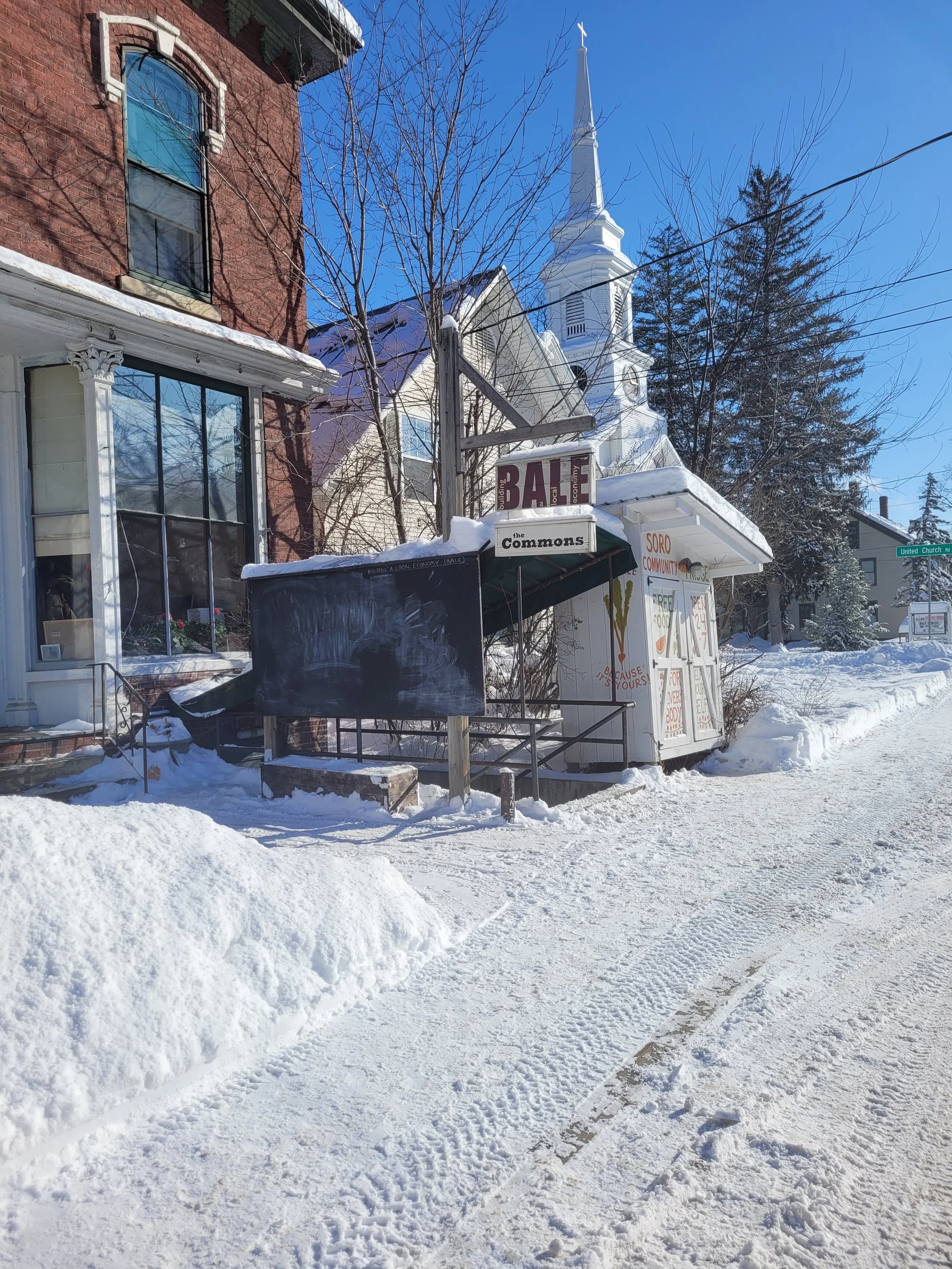
Early on was the beginning of Royalton Community Radio, which still is, I think, a very cool feature of our town actually. It was a tiny box right in that corner there when it began. It thankfully now has a nice space that the Vermont Law School offered up across the road.
So every aspect of anything that could build local resilience. I should say, in my growth, changing over those years when we started BALE, the idea was, we're going to be watershed focused. So we're going to involve the towns of the White River Valley, which is fourteen core towns. Core, meaning the vast majority of the White River is in those towns. There are fringe towns. And I would say, over the years, we have actively and consciously shrunk to South Royalton. In other words, the idea that we could build local, if you look at the town, learning about each town in this area, each town is different. Each town has its own characters. Yes, there's overlap, yes, because we have the co-op people come to South Royalton, but they all have their own character.
And probably a few years in, I started getting people from around Vermont who said, Hey, I like what you're doing. Can you come and build a BAIL type thing, could we be a subsidiary, that kind of thing. And I think probably in the very beginning I said, Oh, that's a cool idea. But then, I don't believe that that's the way real, connected community identity works, for someone to come in and say 'this is how it's done'. I mean, there are basic framings that you could say, Okay, here's the kind of thing we did. For example, this space, which we have now had for twelve years. I walked in, back when I was exploring the other areas, I walked into Hardwick, I walked into this place called the Center for Agricultural Economy that had just started up there. And actually, Grace is probably a little bit connected with that, because she's up in that area. And there was a storefront that nobody was in, but there was literature and things on the wall. And I was sort of blown away by that idea. And I thought oh, we definitely need to have a community space. So when I started this community, when I found this place-- Side comment, when this place was for rent for $650 a month, I went to the landlord who owned the building at the time, and I said, How about $600? And he said, Okay. And then the next year, he reduced the rent to $500. So we've been paying, since then, $500. We actually just got noticed that it's up to $550 [laughter]. You know, different landlord. Now we have a different landlord, and in fact, that landlord, when he sold the building, insisted that he sell to somebody to make sure that they don't kick us out.
So that's the feeling over the years. Obviously there's very different cultural sets of community in and within South Royalton. And you know, people who come in this door are not everyone. And I think over the years we've learned, because of our mutual aid, because of that box of food that's endlessly filled out there, that we are sort of helping to cross cultural divides, and that's, I think, an important piece of work that's completely ongoing all the time. Or at least ongoing to be attentive to, whether we're actively working on it, we need to be attentive to that.
V: I've got a bunch of follow-ups, but I would love to hear how you [Bella] got connected to BALE and joined this illustrious panel.
E: I know I'm putting you on the spot because you said you just wanted to mostly listen, but Bella recently founded an organization that I felt like could be a good example of when you were looking for that genealogy. So I think it'd be great if you also shared about that.
B: Okay, yeah. I guess I got involved with BALE because I was a student at the law school, so that's why I moved to Vermont. And I moved into a house down the street with six other roommates, and I still live there now. When I was a student, I came because I really wanted to help make the world less terrible. And I think a lot of my education and pursuit of working in law and policy was dedicated towards doing that, as are many students at the law school. But I sort of felt that when I was a student, I was looking for more-- myself and a lot of other people usually get into that work because you come from an organizing type background, and I was just kind of looking for more opportunities to get involved. You know, you're learning so much in class. But then sometimes there is a lack of opportunity to do hands-on work that isn't just, like, suing somebody. [laughter] So I think I found BALE through there. I also passed it every day on my walk to school. And I was like, What is this very interesting place? I guess that's how I got involved. I originally joined the White River Node, which was a smaller sub-group of a larger climate justice organization called 350 Vermont, and that's where I met this amazing crew.
E: And the White River Node meets at BALE twice a month,
B: Yes, the White River node still meets at BALE twice a month, and they're a really wonderful group. Also doing really cool things, I also co-coordinate the White River node with my friend Dwight. One of the cool things that the White River node is doing right now, they did this really amazing project where we're trying to get a thermal energy network built here in South Royalton, not only for climate reasons, but also our affordability crisis. The price of heat is something that I feel like really impacts people in Vermont, and specifically here. So that is a really cool effort, and has involved a lot of law school students and the Energy Law Clinic to kind of do the initial grant filing and preliminary study and stuff like that. We'll know more about that this month.
I guess that's how I got involved. Then I just would come to tons of different community events, and as I learned more and got more involved, the more I wanted to do. The group that I started was the Vermont Coalition Against Factory Farms, and BAIL is our sponsor nonprofit organization that sort of helped us form. And that really came from a piece of legislation that was brought forth in the previous legislative session that, essentially would have removed people's right to sue a polluting factory farm or industrial farm. And it was basically created by the organization, I don't know if you know them, they're the American Legislative Exchange Council. There are all of these areas in the United States that are dominated by factory farms, rife with cancer. It's a huge public health issue, but a lot of people just don't know about it, because all the people it affects are poor, basically. But they were literally copying and pasting a model ALEC bill, and tried to bring it to Vermont. And it was just so terrible.
So through kind of learning about and talking with that, and also talking with people who work at Rural Vermont about that issue, I kind of learned that because Vermont is such a special place, and there's such a focus on the environment and a really great, kind of small, alternative and independent farming scene, I think a lot of people think that factory farming isn't an issue in Vermont, but that really could not be farther from the truth. Like, one of the primary reasons you can't really swim in Lake Champlain in the same way that generations past used to be able to, is literally because of industrial dairy farms dumping off their pollutants directly into the lake. So that's a big problem. And so we started that group, and we're trying to do some organizing now, and do some research around the Cow Power Program in Vermont, and how to challenge that in a way that doesn't, like, isolate people who are working in the dairy industry. So that's also my background.
And then I also was unemployed, and was really looking for more work opportunities. And so Elena really generously invited me on in a challenging season of my life to help work with the South Royalton farmers market. And that turned and took a very stressful financial situation into, like, one of the best things ever. So it was really very nice. That's a little bit about me.
V: Where did you move from before you were here?
B: I was living in Massachusetts with my family. During COVID, everybody got sent home, and it was me, my grandparents and both my parents all living in one home. And then I graduated college, and then went to law school here.
V: Thank you for sharing all of that. I'm so interested in each of your origin stories. I'm wondering if you can talk a little bit about BALE's relationship to a commons and commoning and how that idea has informed what you're doing, because it's definitely a key word that made me think, you know, I need to talk to you all, That's core to what I'm investigating. So how do you use the idea of a commons? How did you encounter that idea, and how does it impact how you work now?
C: I mean, I think in terms of my thinking of this space, what's happening is the commons, whether it's sort of physical commons, or even the air and the water, it's all being rapidly removed from our lives. And so rebuilding the commons is definitely a framing that I always like to emphasize. This is the BALE Commons, and I'm the one-- I know others don't use it, but if I write something, it's the BALE Commons, even just to put that word in people's minds. Also when I usually write, I write BALE and then parenthesis, Building a Local Economy. Because BALE, you may well live in this town and know what BALE is, but saying it again, it's a process of keeping in mind important things that you value to be. To sort of pin it, penetrate what and how people think of this space, when they call it the Commons. And I always call that The Commons out there. I mean, it is called locally 'the green', but it's sort of an emphasis that that is the common space for the community.
And it's actually one of the reasons I like South Royalton a lot, because of the layout of the town, with that green in the center. When we started BALE, we had a very different cultural town leadership. The green was precious, and you weren't allowed to do things on the green. COVID was really the moment where it transformed. The town sort of realized the kind of resource that it had as a commons, and so it's actually become wonderfully more accessible. I think the politics of the town have also shifted so that they have made it accessible.
Early on BALE would do Growing Local fest. So we combined that, and we did that on the green. We had to get reservations, we coordinated with the high school to get their tent, because they have their graduation tent, and we asked if we could use it for free, because back then, we were cheap [laughter], didn't have the money. And we did actually several years of local fests where we had one whole tent that was simply to invite every community organization to have a table, just so that people could come in and walk through and see, oh my gosh, this is an organization that exists in my town, or the next town over. And it was like 40 different organizations, a couple of which I had never heard of.
So in my mind, that connects to what the Commons is. Also building community resilience, I guess, is probably where it lies. But I think capturing, recapturing as much of the commons--and that's a very broad, broad, broad term, in my mind-- is a vital aspect of what we need to be doing.
E: Yeah, and I think to add on to that, just a little bit, one of the ways that we think about that work is with the farmers market, for example. It's a way of formalizing that way of thinking about the green, and doing it twice a month through the summer season. But we're also looking at, what are we injecting culturally and spiritually into the commons? We're reclaiming the right to be celebratory and joyful and play music and have children finger painting and things like that in public view, in a space where everyone is welcome, where there's no financial barrier to entry, etc. And that's something that we're very intentionally trying to stitch back together some of the cultural fabric of celebration and some aspects of ritual. You know, honoring the seasons of the year and the different qualities that those seasons have for communal life. I think that that's also part of our work on the commons
V: That's so important. I'm wondering if y'all could talk a little bit more about other projects, or work or thought that you feel like really contributes to what you're doing at BALE, some of your project ancestors or precedents, kind of tracing the headwaters back a little bit, maybe.
E: Maybe while Chris thinks about the history piece, I just want to say that none of us mentioned that this space, the commons, also has a function as a rotating art gallery. Work just came down at the end of last week, which is why the walls are bare, and the walls are usually not bare. Next week we're going to hang signs that have been painted by Resistance Hub joiners for rallies. And we're going to exhibit the art of resistance. And that is also kind of a pop-up thing that we want to do for an art event that's happening in the whole village once a month, that's kind of an art crawl between different storefronts that we participate in. It's a nice way for us to highlight our work as a resistance hub, and tie it in with our work as an art space. That's definitely another service that we offer to the commons, is that people can wander in at any moment and look at the art.
V: You've got really nice track lighting. [laughter]
E: Yeah. And people often, I think, do feel invited. Not everybody, but I think often when people do feel invited to just walk in at random. because they're passing through town, it's because they see, oh, there's a gallery, there's art on the walls. That means that I'm invited in.
C: I'm trying to speak to the ancestry question. What's coming to mind for me is more of a personal shift that's happened for me. Because right when COVID hit is when I spent personally a lot of time learning to resist the norms of capital within the context of even this, of a nonprofit organization. And now I always think of nonprofits as tied to the philanthropic industrial nonprofit complex. It's rigged. It forces you to write grants that fit somebody else's definition. Coincidentally, at that time, we had a funder who was going to fund us for five years at a substantial amount. So I stopped fundraising for five years. So Elena got to win an organization that had no fundraising track history for four or five years, basically [laughter]. Congratulations.
But that was really tied to looking at the systems that we are in more deeply and finding myself-- even before five years ago, I think maybe at some deep level in me, I've always had some connection to wanting to feel Indigenous and with Indigenous people. So I made an effort to connect, and I have now two dear Indigenous people, one of whom is now on the BALE board. Recognizing that in so many ways, the Indigenous culture is where we need to find many of our paths of survivability or resilience. I think the ancestry to me is, I guess, personal, although bringing it forward and working. I work with Earl, who is Indigenous Abenaki/Cherokee, on a series that we've been running for two years called Hoodwinked In the Greenwashed Mountains that we do. We've actually moved from here over the law school for better technology, more involving law school students. Which is something we haven't talked about, is the significant role of the young people who come into this area through the law school, who are wanting to engage in community life.
E: I want to talk about that next.
C: That good old building over there. But to get to my point, I think working with Earl, and I also have worked for many, many years now with a dear woman, an Indigenous guide, Sherri Mitchell, who's a Penobscot elder over in Maine.
E: And they're both activists. Earl is an environmental activist, and Sherri is a lawyer and environmental justice activist.
C: So I guess I'm only speaking to how that influences my work, which is more of a personal ancestry.
E: But the link with Sherri Mitchell’s work is also sort of how you hooked me in, and probably a lot of other people. In terms of that heart-level connection.
V: Yeah, tell me more about that.
C: Yeah, Sherri's pretty amazing. She's written a book called Sacred Instructions: Indigenous Wisdom for Living Spirit-Based Change. And is a holder of a lot of deep wisdom. I don't know, I'm trying to get at that. I like just thinking about, you know, when Elena came here and was drawn to BALE. Or Bella came in the door. And BALE, the fact that we are here, the ripples out of building strength and community, getting people-- it doesn't have to be through BALE. It can be their own creative thing. The community radio station, indeed, was mostly one person's energy. You know, bring it. We provided capacity, initial capacity for it to start. And that's happened over and over again. Like the White River Investment Club. It's on its own. It's a thing that happened. The community solar is a thing that happened. So I don't know if you call that ancestry, but it's connecting. It's sort of an invisible web, like I always think Occupy, when Occupy happened, and then all the reporters came in afterwards, at were all, 'Look, nothing happened, it just fell apart'. And huge amounts of invisible-- not invisible, but under the radar–
V: Underground. Terrestrial. Absolutely.
C: A cultural shift happened. And I think that's the kind of, again, using that word ancestry. But you know what it is. In some ways you can't particularly articulate, but it's alive. At some surface, under the surface.
E: I appreciate about the picture that Chris is painting where there's this one stream of ancestry that is in the like, nonprofit, environmental, land and food access stream of things, and many organizations that Chris helped found or organized in, or worked in, and then this deeper thread of ancestry that I think is in a more spiritual ancestry for BALE that's like this commitment to listening to Indigenous ways of understanding our interconnection with each other, and with the natural world as a whole, and that that's a crucial piece of our identity that maybe not everybody knows about. But I think Earl, who is our board member, is interested in articulating in more clear ways that also, at the same time, really respect his boundaries about what parts of his culture he is and isn't able to share through an organization like this.
Another thing that came to mind for me when Chris was talking about the nonprofit industrial complex and fundraising. You know, despite Chris not fundraising for five years, there is a fairly consistent about $20,000 that will come in from our community every year. And that number has gone up and down over time. But I think there's this core of support, that people in the community will pool their resources to keep this project going. And I think that that is part of what makes this a commons.
I'm also thinking and looking toward the future and the way that younger people, who generally come to us through the law school, I'm just thinking about this-- two of the women who are involved in our mutual aid food pantry project just met with a law student who is developing an app, some kind of technological platform for organizing mutual aid projects that I still don't understand. [Laughter] I'm still waiting to meet her and understand it on a technical level, but I know that there is something new coming forward, where younger generations who are working on these digital networks and, like, the digital mycelium, and how digital technology can serve the the goals of community resilience in a way that's aligned for us. I know that that's coming forward, and that that's going to be part of what's next.
V: And is also a commons that is getting rapidly enclosed, that we have to kind of keep.
E: Yeah, exactly like we have to fight to have some autonomy over how we use digital technology, right, before we're fully boxed out of it by the surveillance state, if that's not already a done deal, right?
V: Independent radio, that's a great intervention.
E: There are, I know that that's such a big thing that generations that are younger than me are far more plugged into and I'm excited about being, you know, a bridge to that and learning more.
V: Yeah, I'm really interested in what I'm hearing about that kind of passing on or knowledge transfer, or shared learning, between an organization like the law school, and between different ages and between different community groups, and also that piece of what can and can't easily be shared if you aren't experiencing it. What I'm really interested in investigating and discovering with this project is hearing, what has been successful in sharing what you're doing, the heart of what you're doing, and what about that is kind of hard to encapsulate in-- like, you can't write a curriculum that gets it all the way there, right? This is not my best formulated question, but I would love to hear how you're doing that kind of information sharing, information transfer, communication about what you're doing that brings people to you, and also the challenges you're encountering with that work too.
E: Like between BALE and the community, or like amongst ourselves?
V: Within, I guess, whichever one feels more pressing.
E: I almost feel like I need an example.
V: Yeah… I think a thing that's necessary to create movement spaces where you can trust each other and move, you need a sort of deeper way of sharing information. I'm looking for examples of that and ways of communicating all the things you can't just share in a 10- minute video in a database.
B: I just want to say this, because I have to go back to work. But I think maybe one helpful example is, going back to what we're talking about in the past legislative session, with that really nasty bill. How this all kind of happened is, I was sitting at home and I was reading the legislation. And the only reason that I picked up on that something was wrong is because of previous experiences that I had with a woman who, her life was totally ruined by a factory farm moving into her community. And had I not met her and heard about her experience and had her open up to me about the health concerns she had about her child, I never would have been able to identify that. And then even when I was like, Oh, something is off here. Okay, who wrote this bill? Like, what is the language behind this? The only reason that we were able to figure out that it was the American Legislative Exchange Council is because of Earl Hatley, who we were talking about earlier, who's on the board at BALE, fought the exact same bill ten to twenty years earlier in Oklahoma, and he remembered it.
And so then I was able to learn so much from that experience, and then both of us, with that knowledge, were able to then talk with other allies and community members and other organizations who could do that work, and then get law students involved and be like, hey, if you're learning about legislation or strategic lawsuits, and fighting against industrial agriculture, this is something that's actually happening here in our community that you could do something about. And then they were able to write things in and talk to legislators. And one of our local legislators, John O'Brien, who runs an organic farm over in Tunbridge, who sometimes comes to BALE events, sometimes we'll reach out to him for various different things. But he said that was really instrumental in making sure that that bill didn't go through, at least the worst of the worst of it. And so I think that maybe that's kind of an example of, just like, sending out an email blast, call so-and-so and tell them not to vote for this. It's just something about it. The way that it all came together was so relational.
And also, another thing is, sometimes as a young person you almost feel like, oh, I don't know if I have the authority to say I have knowledge about this thing, or I can make change in this way. It almost feels arrogant, or overly prescriptive. And I remember when I was first learning about it, I went up to Chris. I was like, Chris, do you know about this? This sounds really weird. And he was like, No, but you could talk to this person, or talk to that person, or you should email Earl. And I feel like our relationship and your mentorship of me gave me the confidence to feel like, okay, maybe something that I could say could be valuable here. And it was! And I think if we hadn't had that relationship, I probably would just have not said anything, because I would have just assumed that I was wrong. So yeah, and unfortunately, I must leave now.
E: We love you.
V: That's so wonderful. Thank you so much for coming and talking.
B: Of course, I'm sad that I don't get to hear the rest.
E: Yeah, always a gift to have. I was basically just gonna say what she said in a general way, without the beautiful, precise example and but yeah, I think we live in a community where there's a lot of genuine intergenerational friendship and mentorship, because a lot of people who come here to farm or to work in fiber arts or, you know, to play music, like folk music, or whatever it is are, if those are younger generations of people, they're connecting with older generations who have been doing that work for a long time and forming genuine friendships. That's how I that's one of the beautiful things I see about our community.
V: Thank you so, so, so much. I'll be in touch. Have fun at school. I probably should start wrapping up before my little feral babies tear down your library. [laughter] But there's a couple other pieces I'm super interested in, and I might pester you all with follow up calls. I'm interested in how you do decision-making. You mentioned community events. How do you do decision making at BALE? Are there methods or practices you use, or what's informing the way you do decision making here? That's interesting to me.
E: I feel exposed! Well, in relation, in the resistance hub, we are trying to use sociocracy to inform–
V: If I had to guess. I would have guessed sociocracy [laughter].
E: But BALE as an organization in general-- I'm the only person on staff, and there's a board, and then we have what we have just been calling our circle. When you were talking about operating within, you didn't use the word circles of trust, but that's the terminology that I've been using. I try to stay very authentic to, what is our actual circle of trust around this particular issue and how sensitive it is, and then what's the slightly wider circle of trust or involvement, as we get to things that are maybe more community-facing and touch on less challenging terrain. And so there are circles of people who are deeply involved with stewarding this space and this organization. That would be like Chris's partner Sylvie, who teaches yoga here, and who does a lot of caring for the physical space. Fran Miller, you know, just lots of different people. And I think decisions tend to happen through very deep, involved conversations between people, and inside of relationships where it's like, oh yeah, we're resonating with this idea. We're exploring this.
And then, you know, is there enough organizational capacity to move forward with that in X, Y or Z way, or are there enough community volunteers or people interested in participating in that. It's kind of emergent and organic. As an organization, there are not a lot of protocols in place. I'm just talking about right now, because I know that BALE has had many different incarnations. In Chris's time here that he's talked to me about having a very formal board structure, with very formal board meetings and processes, and then kind of both extremes in that way. And right now we have a sort of new board, one long-standing member, Earl has been on for a couple years, and then three new members. And it is very organic and relationship-based, and the same kind of ethos of, what capacity do we each have to give to the commons and to participate and to contribute our skills and knowledge? And what's resonating? When we wanted to revive the farmers market we did put out community surveys, both to vendors and prospective attendees of the farmers market, to find out, do people want this back? What day of the week would work for them, what frequency? And that was helpful to understand how we could best serve the community.
But I do think I have a certain amount of resistance to some of the stuff that I see as a kind of performative of, you know, we're doing this objective analysis of what this community wants, whereas our community is also us, who gather here and who put in our time and effort here. And so in a lot of ways, it feels like we can make decisions from what is moving authentically amongst us, and bring that forward, but maybe we will get more systematized in some ways as time goes on.
C: Yeah, early on it had more structure, with committees, but I agree, and I actually like where we are now. What she just said around more organic structure, you know? So, like we're doing this Hoodwinked series, and we just decided to do a four-part series at the law school this winter/spring. So our team is two law school students; one is the head of the Environmental Justice Law Society, one the head of the Energy Law Society, Earl and I, and we did the planning. That was pretty much organic connections that started last year, because these law school students arrived last year and showed themselves up. The students are usually the older law school students who come in the door, and not the fresh from college ones who tend to, I don't know, not feel like, 'Oh, I'm in this community. Let me participate in it.' That's quite often the case. But in recent years especially, I think I've seen an increase. I can say that since the very beginning, students who come, who have been to the law school, have helped BALE in huge ways, in all different kinds of ways, from the very beginning, and that's true. It's actually increasingly true this past year or two. So that's an organic configuration with two of us who have a lot of knowledge, and the law school students who know the ropes over at the law school, because the law school increasingly is cutting off from the community. So it's actually these students who are pushing it open by having these kinds of programs.
E: Yeah, I think you sort of hinted at this in one of your questions, I think, but we do sometimes have a problem of articulating in ourselves in a way that's easily fundable. I think we do. And I feel like Chris and I are both somewhat proud of that, because I think we share similar feelings toward that philanthropic establishment. I don't have a background in the nonprofit world, and I don't identify as a professional nonprofit worker or even a professional community organizer or anything like that. I identify as a community member. And so for me, that feeling is very strong, as a parent in our community, as a granddaughter of someone who was very active in town politics, as somebody stewarding a piece of land in the community, as a patron of all the local businesses, et cetera, et cetera. I feel like a member of this community. There are lots of different circles and cultures within our community, but I think that it feels valid to me for us to move from a place of, what do we want to see? What do we want to build here? And that we don't have an ethos of, 'we are a professional organization that has come to serve someone outside of ourselves and so how may we serve you all', so patronizing, at the same time. And maybe that will become more gracefully articulated over time.
V: I love that and I think that's so important. I'm wondering if there are other things you think you need to share about what BALE is and is doing, and also other groups or people you think I should really talk to on this trip, people I should make sure I get in touch with or shouldn't miss out on.
E: You could try to talk to Earl, because he's come up so much in our conversation, and he has several different organizations, including Ottaqueechee Water Protectors Association,
which we used to fiscally sponsor at BALE and now is its own entity. Well, it was always his own entity, but now is its own 501c3. Earl, besides being on the board of Rural Vermont and BALE, and being the co-organizer with Chris and these law students of the Hoodwinked series, he is representing a lot of the bringing forward of Indigenous traditional agricultural practice, and Indigenous ways of understanding our relationship to the environment, and infusing environmental activism with that perspective and that grounding. Which I think is really informative to us, and Bella, and everybody. He has an Abenaki cultural garden in Queechee as well that cultivates seeds and grows food and shares them with Abenaki tribal members.
Caroline Gordon might be another person to talk to, to kind of flesh out this idea of the mycelium between Rural Vermont.
C: I think I can say one of my favorite things to do, personally, that somehow rolls into this, is connecting with young people. It's only been very recently that I've been thinking of myself as an elder, providing some context of history and wisdom in the community and not feeling like, 'oh, that's presumptuous', or something. [laughter] And connecting with young people like Bella here. After she graduated, I basically said, 'You cannot leave here'. [laughter] You can't, sorry, you know, you're stuck here. And fortunately, for a year she went without a job except for scrapping it together and starting VCAF. And then, of course, luckily, she landed the job right here at the law school. Our Resistance Hub meeting was Wednesday night. There were 20 or so people here, and great conversation. And I met this young law school [student], Jordan. So I'm going over to meet her. Coincidentally, Stuart Blood, who's active in the Resistance Hub as well, went this past weekend to a 20 hour street medic training in White River Junction, and Stuart said Jordan was at this meeting. For some reason, that's a beautiful piece of what I love to be doing. My antenna, or whatever sensibility, is like, oh, here's someone who I can very quickly sense might be someone who can really contribute in the community in some way. To BALE or not, just engage.
E: And I love bringing my kid around and just having him exposed to all these things that people are doing and like these ways of being and being a community .
V: This is something– we're doing this trip with my little ones in tow because we want them to be part of the world, and it feels really hard to do that a lot of the time. The path of least resistance is just to segregate everyone into your little space, and then you don't know how to make those genuine friendships, but when you make a place for it, it's so validated. Like Bella said, having someone who can say 'we need you to share this information that you have,' that word is so important.
C: How old are your little ones?
V: I've got a four year old and a one year old. Just turned one. They're amazing. They were in my last interview, and I'll miss the voice test of having them around, being like, 'help me with my Legos'. But it was really nice that I got to talk to all of you without that. Yeah, we want them to be part of our lives. We want them to have a future. We told them it would be a good world if they showed up in it. Now we have to find ways of doing that.
Building a Local Economy
Elena Greenlee, Bella O’Connor, Chris Wood
South Royalton, VT - January 28
Vic Spindler-Fox: I'm here today on January 28th at BALE, Building a Living Economy, with Bella, Chris, and Elena.
Chris: Building a Local Economy.
V: Building-- what did I say?
Elena: Living. Love it!
V: Shoot! Thank you so much for inviting me into your space. This project that I'm working on, it was part of a funding project that ran in the last few months called Float, which was the funding lab for open agro- ecological technologies. And they did a kind of participatory proposal and budgeting process with a bunch of groups that I've been connected to for a while, and they used a digital platform for everyone to vote on how to disperse funds. And I got $6,000 for discovery, basically. I proposed to this group that I would travel around to some organizations located mostly around Central Vermont, partly because I've been working with Grace Gershuny through the Institute for Social Ecology, and she's been telling me a lot about different groups and history that she's a part of. And I wanted to speak with folks who are doing some kind of place-based intervention toward building sustainable futures, and doing that in a way that is very locally rooted and involves some sort of political or educational component. So, making something in order to change how people live in relationship to land.
I've been working in digital spaces for a long time. I was helping make open source software for farmers, which is really fun and cool, but all of our funding recently got cut with USDA freezes–
E: I'm so sorry
V: Yeah, thanks. That's rough, but now I have the opportunity to do a little bit of something that was local, with people, basically. So I jumped at that opportunity, and you are my second or third stop on this trip. I was in Western Massachusetts and spoke with some environmental artists, and with Pequoig farmers, which is a land back project in Western Mass and then yesterday, I was at In Situ Polyculture Commons, which is an artist residency in Westminster, Vermont. They're pretty young. I think they've been doing that for about two or three years now. And yeah, I'm really excited to talk to you all, because it seems like you have many projects that are connected through BALE.And so yes, that's where I'm hoping we can start, is to hear a little bit about what you're working on here and how BALE got started.