Rural Vermont
Mollie and I connected as early FLOAT cohort members - her project with Rural Vermont for a Mobile Classroom and workshop was super inspirational for me, and I knew I had to find a way to connect with her and others from the People’s Agroecology School if my project was funded.
Just two months after our first emails, we met up at the lovely Espresso Buena in Barre for coffee and talked for nearly two hours. Mollie and Martha are incredible researchers and community connectors, as you can see from the list of follow-up links. This is one of my favorite interviews I was able to record on this trip, and I’m so excited to be able to share it
This conversation has been lightly edited for length and clarity. You can find Rural Vermont online at https://www.ruralvermont.org/.
For follow-up reading, see:
Each One Teach One Agroecology Encounter, July 2022
V: What year was this?
MW: This was November 2021, that first initial meeting, and there was excitement locally about this idea. And the next step was we connected with some leaders in the Via movement who had founded or co-founded agroecology schools elsewhere, specifically in Venezuela and Ecuador, as sort of an accompaniment process. And the question that we were asked really point blank was like, "why an agroecology school in Vermont?'. And we spent the next four or five months working with a group of people, answering a list of questions around why we saw this as a good opportunity for both our local community, and the international community. And really building off of work that Rural Vermont has done– we're super local, but we've already always had this funnel to the international community through Via and through policy work. So it didn't feel like that much of a stretch organizationally. But when the school was first founded, it was just a group of folks having a conversation, really. We didn't have this institutional home. And we decided to ground-truth this idea by having a big encounter in July 2022 called the Each One Teach One Encounter that we hosted in Marshfield, Vermont with a bunch of local farmers and food activists, as well as leaders from Via from six different countries, including folks that are involved in agroecology schools elsewhere. So our idea was to sort of ground-truth this idea, and also help determine, like, what would it have to look like to be used by and useful to our community? Because we're trying to take a concept that we know is really successful elsewhere, and have it be relevant and true for our community in a very different political context.
We had a lot of really good conversations about what that could look like, and one of the things that we learned from those workshops together was that people had a lot of thirst and excitement about this idea, and they also didn't necessarily want us to build something new. Especially in Vermont, we have a lot of really incredible farmer supports, and there's a lot of farmer-to-farmer training and education through organizations like Rural Vermont, and also the Northeast Organic Farming Association of Vermont (NOFA-VT) and other groups as well. We really left that encounter with the goal to transition– Yes, this is wanted, we want an agroecology school in Vermont, we have to figure out what exactly that looks like. Still! And we're transitioning leadership away from this international accompaniment group, and more towards a group of local leaders that can shepherd the next steps of this process.
MW: One of our goals was to really do a better job connecting what was already happening, linking people up and supporting folks that have been doing this work for a long time. We'll talk more about the lineage piece in a minute, I just want to say it out loud so I don't forget. With a specific focus on political education, because that was one of the things that we identified as a major gap in Vermont in particular, or just something that people had less access to and more of a thirst for. That was one of the niches that we identified early on.
We are very much building off of the work of so, so many, including, notably, the People's Agroecology process. Some of the folks that were involved in that process, which I was not one of, were part of the political pedagogical coordination that was originally brought together to talk about the encounter, and the early formation process of the school. I just talked a lot! I'm gonna pass that ball right on to you, Martha. [laughter].
Martha Caswell: I randomly ended up in the Agroecology and Rural Livelihoods group-- sorry, we changed our name, like, eight times!
V: Oh yeah.
MC: At UVM, as a fifteen-dollar-an-hour temp hire after I'd had my first kid. I'd never heard of agroecology.
V: What year was that?
MC: That was in 2012. I did not think I was going to be in academia, and had actually been sort of avoiding it. But I appreciated the way that that group functioned, and was being introduced to something called participatory action research and I was like oh, okay. If you're going to be in the academy, this is the only space where I could imagine being. I have a background in social science and public policy, and so to be in the department of plant and soil science, I was an outlier. But in agroecology I fit. I spent several years working under Ernesto Mendez, who is someone who is named as one of the people who brought agroecology to UVM, and studied with Steve Gliessman in California, so is part of that lineage. I was fairly persistently, in that space, as someone who was lifting up the political education and popular educational questions. Since that was my orientation, I was also just looking for the ways to complement Ernesto as an agronomist and agroecologist He has more of a natural sciences training, and so at some point went looking for some outside support for my curiosities since his mentorship was bountiful and beautiful in many ways, but he didn't have as much connection to the political side of agroecology. And so I went to a USFSA meeting in New Hampshire in 2017 or 2018, and was really excited to be connecting with people who were trying to figure out what food sovereignty and action looked like in this region.
It was tricky because at that point USFSA was following good practice and wanted you to be part of an organization if you were going to join as a member, but they were allowing folks to be support allies. And so as an academic I was able to go and be in that space with them, and became involved pretty regularly. Then at that point they were dividing geographically, so there was a Northeastern chapter and we had several meetings and iterations. And I'm telling you all of this because it ended up that the political education group of USFSA became quite active. and had a course in Florida in late January 2020.
V: Great timing.
MC: Which was a really powerful course, and brought together a lot of people from all over the US, some folks from Canada and Mexico. So if you're asking lineage, there were definitely connections to Via and to other formations that were trying to think about organizing this work, including people who had been part of the People's Agroecology process. Both some of whom were part of the USFSA Northeast region, and who I met more of in Florida. We all hugged each other, got on planes-- and then COVID.
That fall, as part of trying to figure out what we were going to do, there was a proposal that we do an online course in agroecology. The People's Agroecology process previous to that had had in-person encounters as the way that they were doing their work. This was the first time that there was an online course taught, and so it was in partnership with UVM, which at that point was the Agroecology Livelihoods Collaborative -- I'm like, what did we change our name to? [laughter] I'm looking at you. The People's Agroecology class was doing an advanced agroecology course online. So this was another time when we were sort of pushing against what people had done before, and expectations, and yeah, it was a fucking first time, to quote Brenee Brown. There were beautiful things about it, and things that would be very different were we to do them again.
I had known about Nils because I met him in Cuba when I was visiting on one of the exchanges with the ANAP group in Cuba. I met him again in Florida, and by then I think actually we had hired him. He had applied to come work as a consultant with our group in UVM, and so Nils continues to be a connector, in addition to other folks. Jesus Vasquez from Boricuá, who was at that same meeting in Florida. Antonio Tovar. You'll find all of these names that will bounce back up. [laughter] After that process, the Institute started being proposed as a next step for our group within the university. At that point Colin Anderson who had been previously at the Center for Agroecology, Water and Resistance started working with us remotely. The other group that sort of connects all of this is a group of academics who have decided that they want to work with and in solidarity of social movements, which is called the Agroecology Research Action Collective and so lots of the people -- Becky Tarlow, David Meek-- there are all of these people who are bridges in one way or another. Becky was also in Florida. There's a branch of this tree of people who studied in California, Annie Shattuck is another person.
We were then in this process of making an institute. Nils was part of an international program where he was a representative to the Andes region because he's fluent in Spanish, and so he came to Vermont on UVM's ticket and set up this meeting with Mollie. So that just shows you that sometimes the material resource that makes something happen has absolutely nothing to do with the desire, and how then you're able to line it up. It's like, trying to be positively redundant and make something happen in a moment when you're in a place. That has continued to happen, with Nils sort of doing double, when he's able to be here for UVM business, to step in and be physically present for events and other important moments in the process of developing the school.
The institute was founded in Fall of January 2023. We had a global forum to kick everything off, and so that was another moment when folks, academics but also folks from social movements, were invited to Vermont to convene and help us as the Institute to set our course. At that point I was one of the co-founders and co-directors with Colin and Ernesto. We had a really broad geographic representation, folks from Europe, the African continents, Latin America, United States, and it was a really powerful moment for people just to be with each other. I think there was a desire from some folks that we charted a course, and that wasn't necessarily how we left those days together. But I think what did happen in those days together is that there was a lot of connecting and relationship-building that has carried forward since then. People who had never met in person were able to sort of plant a seed, and then from there there's been continued collaboration.
V: I'm really interested in that piece of the invisible or un-documentable or underground connection that enables actual work to happen. As a documentarian, I feel like that's so important and also it's often really hard to get funded, it's really hard to use as a benchmark for success, but that is how things get done!
MC: Yes!
MW: Yeah. Like how many countless hours of Martha's time in particular, in advance of this 2022 encounter which came together in three months I think--
V: Wow.
MW: --And Martha hustled to get visas using the connection to UVM for all of the internationals that came, that really helped add to the richness and legitimacy of that event a huge amount, and which would have been impossible if you weren't in that position, and weren't willing to do that.
MC: Yes. Yeah, without pay.
MW: For the record!
MC: I think, too, here's where it gets tricky. Some of those things that you're doing are necessary, and if you put too much light on them, then somebody who has a legal or other reason for not wanting them to happen sees that it happened through that avenue and then shuts that door. [Yes.] And so there's this really funny tightrope to walk between, thank you for the recognition, and can you not say it any louder than that? I think that has been one of the ways that we have, as the group at UVM, tried to live being good partners to social movements. To say we will use our institutional power when we can, and it goes under the radar, necessarily. And I think there's questions then too about how, when you then start to talk about funding and material needs, how you express the power of in-person opportunities to build relationships, when it is then nearly impossible to track that power. But I can't tell you how many phone calls I've been on with people who I've met in one or another agroecology space, where years later we're still in communication and they're saying "Oh yeah, we started working together because of that short course in Santa Cruz in 2015," and you're like "Oh yeah, wait, do they know that?" Do you know what I mean? There's not a very effective way to capture that data, post-[event]. It seems like part of what you're chasing is making visible those webs?
V: Yeah. So I'm also right with you on this tension of, there's a difference between knowing of something and knowing something. [Yeah.] And also, documenting something in a way that's visible to an institution necessitates ignoring some things that are true but important, and also not exposing vulnerable things to the conditions that will take them away from existing.
MC: That's right.
V: But then also, once you've documented something in a way that's visible to the state they say "this is all there is." And I want to talk about ways in which that is not all there is, that there is more, some of which can't simply be captured through better, more rigorous data collection.
One of my things is documenting the undocumentedable. Making a space to be like, "And there is more to this question which you don't know, and which you won't be able to know no matter how much data you have!" It's uncapturable. And part of that I do think is why I'm here in person and not on a Zoom call with you all. l've been in the digital zone for so long, working remotely, and there are many people whom I've met on a zoom call and know of. But I do think there's something fundamentally critical to being with someone, in their place, and hearing what they're really about. And I think that's also connected to land knowledge.
Part of my motivation for this project is hearing a bunch of proposals-- not through FLOAT necessarily-- of the idea that we can document and keep and maintain ancestral knowledge, knowledge from our elders, in the form of like, a video library. And I think that's not only not possible, I think saying it's possible through a video library is wrong. [laughter]. It won't be neutral, it will be actively destructive. But that we should talk about the ways in which a signal can be transmitted. You can't transmit the whole, the totality, you can transmit the signal. And that's important, and we should talk about that. We'll see how I end up formulating this for the various audiences for which I hope this information will be helpful. But that's some of the context I'm working with.
MC: I'm interested in that example, because it makes me think of-- I teach an agroecology class in the Fall and seeds is always a really tender conversation about, what is the utility of seed banks? Because if our one hope that that genetic capsule lives on is frozen somewhere, while the world out here changes, is that seed even going to be viable anymore? [Right.] Within the new conditions? I feel that way with that knowledge. There is something about the kernel that needs to be transmitted, but that everything else around it, in order for it to survive, has to stay vibrant and evolving. Maybe that's another example I can share, because I'm always looking for, what is another way to get that to folks? I think it usually resonates with folks, but there's also a desire to save something and know that you've saved it. Because the other feels vulnerable.
MW: Yeah. So much of what we're trying to do is create a container for formación, for training, and for political consciousness-raising. And one of the questions that we've been diving into a lot is, what are the conditions that we could put in place to help create the container, to make that easier for people? You have a really nice way of saying it. To help them make that political leap in their own awareness and understanding of the world, and how the various pieces fit together. What's an easy way to help make that easier? I think the Vermont school has been really important to that, and we're learning how to spread our little wings and also what this looks like.
Since we were founded we've been incubated by Rural Vermont, and in 2023 in the fall we were taken on as a formal project of Rural Vermont. We're sort of acting as the educational branch, but we're figuring out in a really active way what that looks like, and how to have less distinction between these two things that are distinct and are totally interrelated at the same time. That's an ongoing question. Our main offerings have been the short course in People's Agroecology, which we've had the last two falls in a row, summer-fall, and then ongoing series of work brigades and political education events. Martha mentioned Organizacion Boricua in Puerto Rico, and they really have been hugely influential in our process, and one of the folks that have been accompanying us in a really close way. We also have folks from Ixiim Uleew in Nicaragua that have been coming in as educators and advisors in this process, also involved since the beginning. And you also mentioned ANAP in Cuba, that was another really formative place where a lot of the members of our collective were able to receive additional training. This part of it is, we're trying to take this model from the Via landscape, and we're hearing from that community the importance to do this work in the mouth of the wolf, apparently, and how necessary it is to have a network of these schools in North America. Hence, North American Schools of Agroecology. I will say, this is aspirational. I think we believe really strongly that in order to be relevant, we have to be rooted in the needs of our grassroots community. Our territory is Vermont, so we have to really be grounded in what's happening for folks here, but there needs to be more of these schools, across different regions, throughout the country.
MC: Our collective is currently about half folks who reside in Vermont. The term "Vermonter," I don't know if you know how funny it is, but like, Vermonters call you a flatlander until you're like seven generations in.
V: Sure. Very, very similar in East Tennessee.
MC: Okay! And so many of us have lived here for 20 or more years, some of us with kin who might count, but all doing work that's really rooted here and committed to this place. And then also being mentored and accompanied by folks from other contexts, as Molly was mentioning. And so to your point about the importance of meeting people in person and knowing them in their place, we just got back from visiting one of our collective members in Mexico, where they're based. Being able to do an exchange with this school, the Feminist School for Agroecology that they have there, it's that kind of internationalism where what we're doing is not looking to replicate the way that they held their meeting, but instead sort of distill down; what are the principles of the way that they are doing this outreach and and pulling people in? It was helpful because, you know, several of the women stood up and were like "yeah, you harassed me for five years to come to these meetings, but now I'm somebody who's bringing people myself." So it's really helpful for us in other contexts to hear that there is resistance, there is hardship in terms of some of the silly material things of like, yeah, project funds go and then dry up, and then you have to figure out how you bridge through and don't lose momentum and all of these things.
MW: I also just want to mention Union Paysanne, because they are the Quebec member organization of La Via Campesina, and they did have an agroecology school, sort of decentralized, which is also our model-- so we don't have brick and mortar anything, really. We have different host farms that are campuses, and we work with different farmer-educators to be our teachers, and that's similar to a model that they had I think in the twenty-teens. And it was sort of short-lived, but it did work well for them. They ran into some funding challenges but they're also in a really exciting place right now. Martha and I went on an exchange last fall to meet with farmers from up there, because Martha's family farm is ten minutes away from a whole hub of active farmers with Union Paysanne in Quebec. So I just wanted to lay them down as another influential member organization that's been part of this work and have sent representatives to most of our short courses and the 2022 encounter as well.
MC: And the National Family Farmers Union out of Canada has also sent a huge cohort this summer to work with us. And then we were in Sri Lanka for the Nyeleni forum with folks from the NFU and other folks. So again, this is the bridging of, how do you stay connected to the global movements that are doing this work? And it's through those kinds of convenings. Then, explicitly there, everyone's going in representation of an organization, you can't go as an individual.
V: So I want to hear how you all got to FLOAT but I'm also interested in-- you said this is your hometown?
MW: Not really, but I live down the road.
V: Geographically, where are you coming from? And where are you now? That's also interesting to me.
MW: Yeah. I grew up in New Hampshire, and I've lived in Vermont for close to twenty years.
V: Happy anniversary!
MW: Thank you! And I've been engaged in farming and working with farmers for pretty much that entire time. And have lived in different parts of the state, for the last ten plus years it's been central Vermont. I did live in Burlington, and then a little bit south of there for a minute.
V: And you're not from Vermont--
MC: I'm not from here! [laughter] I'm from Ohio originally, bounced around in big cities. Picked up a Vermonter in one of those big cities, went to other big cities, they followed. We ended up here.
V: Where in Ohio?
MC: Columbus.
V: Yeah, awesome. My in-laws are from Akron, I went to school outside Cleveland, I love Ohio.
MC: Oh, yay. I mean, we are good people. [laughter]. Yeah, twenty years also [in Vermont].
V: Hey, happy anniversary.
MC: Thank you. We'll have to throw a big shabang.
MW: We should.
V: And then tell me how you got into FLOAT, a brand new baby project with many little threads.
MC: Oh, so here's the thread. The institute, at that point the Agroecology Livelihoods Collaborative had courses as part of a graduate certificate in Agroecology, and in the spring of 2020 what we usually had was a three-week online course and then a one-week in person. We had to pivot really quickly because we couldn't have anyone come, and so we had our first ever fully online cohort, and Maggie Nice of 11th Hour Project fame was in that cohort. And was a lovely student, made good connections, and then we didn't talk with her again until Colin was working with us to do the Institute. Colin had been doing a research project on financing agroecology, and so had been interviewing a bunch of foundation folks. So we had a relationship with Maggie, and we approached the 11th Hour Project for funding, and they were one of the founding funders for the Institute, and a few months later they let us know that they were hiring for a technology position, and I felt totally betrayed! [laughter] I was like, I'm sorry, I didn't think you did this, I thought that's why we liked you! And so Maggie's telling us about this, and we're on a Zoom, and all of us are just kind of looking at each other like, "is this really happening?" and then she described what she meant by technology, and then they told us who they had hired, which was this person who used to be really active in Farm Hack in Quebec, and we were like "Oh yeah, we'll talk to that guy." That was Samuel [Oslund].
V: Okay, of course.
MC: So they hired Samuel, and then he and Maggie both came to that forum in the fall of 2023 that I mentioned. So since then he has been a guest lecturer in my class every year to talk about technology, and he was in Sri Lanka at the Nyeleni Forum, and he mentioned this FLOAT process there, and we had been talking about this idea of a mobile classroom for a really long time, and I was like, "Oh, would this be the kind of idea that would be--?" and he was like "Yes!" and so that's how this started.
V: 11th hour! I do think of them as like, a daddy of these projects. [laughter]
MC: Yeah! So McKnight and, I don't know, there's just the funding circles, I think they're both members of the Global Alliance for the Future of Food, and so McKnight and 11th Hour I think have influence there. The funders have their own space, and then you'll find that Agroecology Fund would also be in that, and then they encourage their funded groups to then interact with each other, to be able to then multiply the investment.
V: Absolutely, interesting. So I guess the next thing I really want to investigate-- there's two branches, you can pick which one sounds more interesting to you. One is the idea of commons and commoning, and rebuilding common shared infrastructure; and the other is how you interact with and use technology as a concept. I've heard little possibilities of both, and I don't know if we'll have time to talk about both, but which of those makes you want to tell me more?
MW: Good question. I mean, if we talk about technology, you should just know that we're a very low-tech group [laughter], because we're learning a lot, and so our version of technology might not be the same as other people's versions of technology.
V: There's also like, "technology" the clip art version. and then how you actually move information around.
MW: Yeah. And then I think the commons is a principle that we're super interested in, and just collectivism in general has been another sort of lineage thread of why Vermont was a good location for a school, was because of a history of cooperativism and back-to-the-landing. We have a number of really exciting cooperative farms that have a long history here that have been doing really badass work. I'm not making an argument for one or the other, really. What do you think?
MC: Yeah, I can go either way.
V: I can ask you technology questions over Zoom easier than I can ask you about Vermont's specific history, so let's do that one.
MC: Great, there we go. I love when this decision is made, not by me. [laughter] I don't know, can you just decide please, Vic? [Laughter]
V: Yes, absolutely. I've got a four-year-old and a one-year-old, and so every day is like, what's the right-size decision for each of us to make?
MC: Yes, good, totally.
V: I was also thinking about that when I drove, you know, the 12 hours to get to Vermont. It is a really unique and specific place for experiments in how to do co-ops specific to place. So tell me more about how that works for you all, for your specific projects, and just what you see.
MW: Well, one of the founding members of our collective sadly passed in 2025.
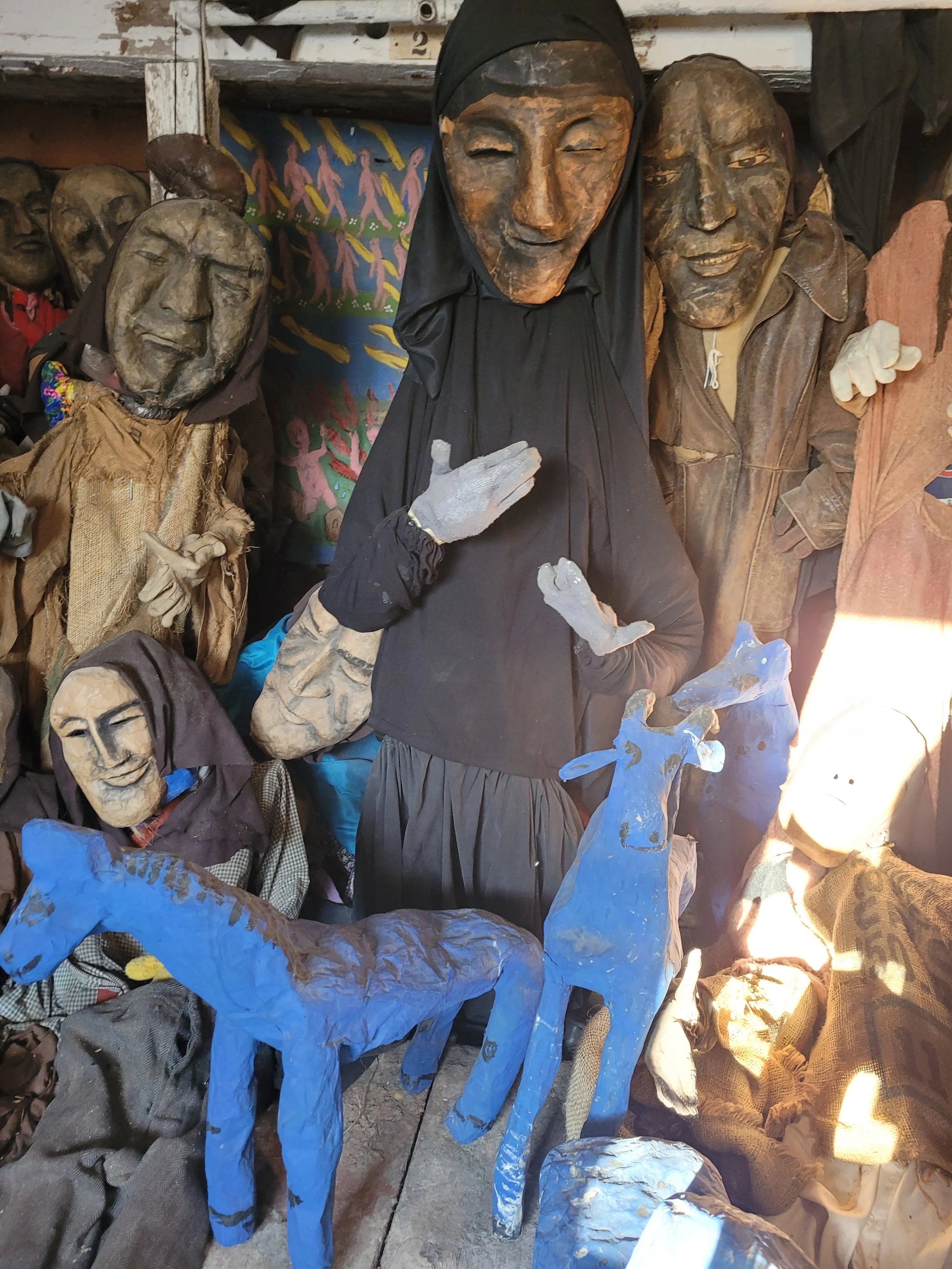
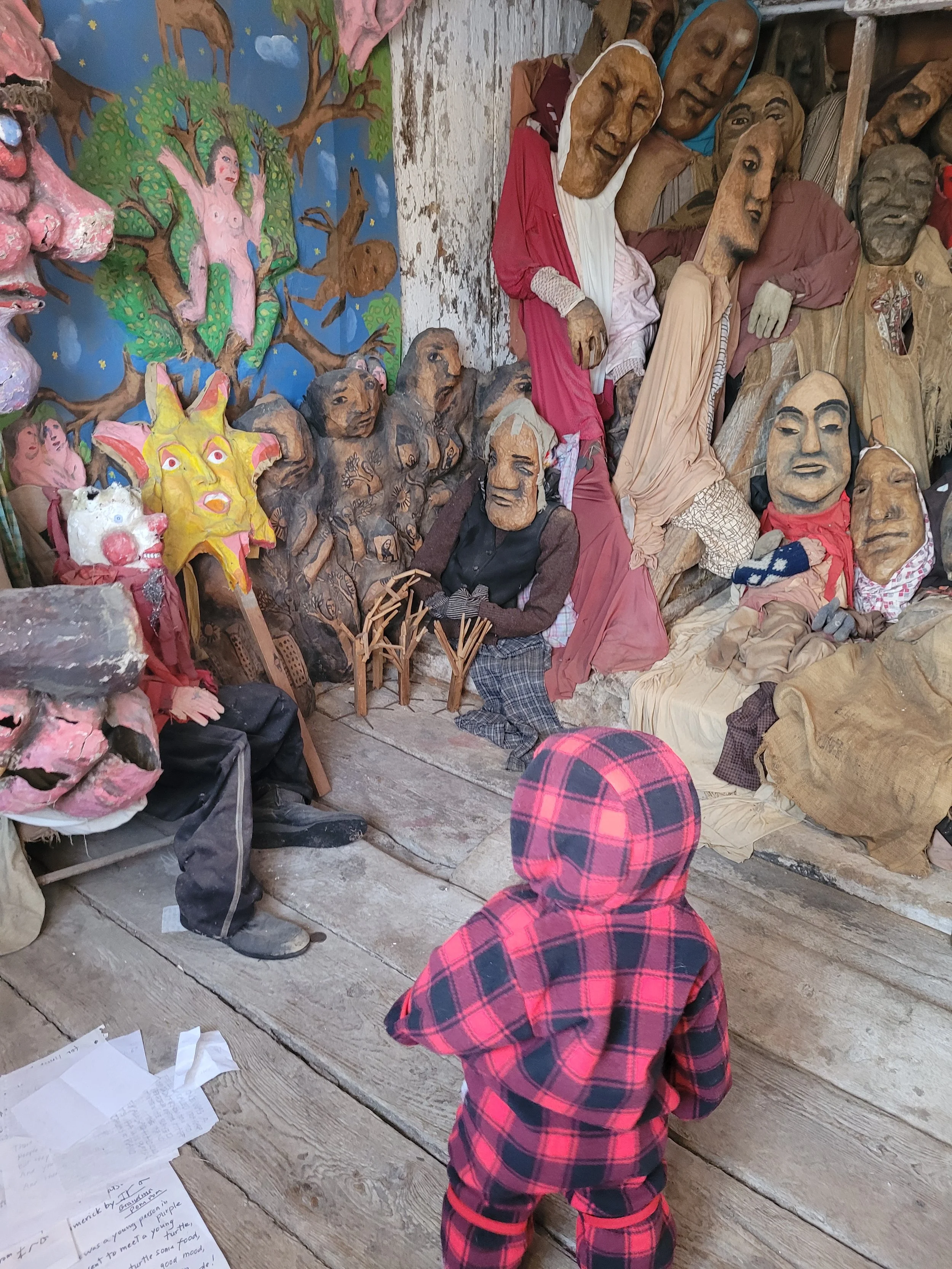
His name was Bruce Kaufman, and he was a long-time vegetable producer in Vermont with Riverside Farm and a number of other farming enterprises over the years, along with his wife Judy Jarvis. He was really a huge educator and link to the farmer cooperative movement in Vermont to us. He'd been involved in founding multiple farmer-led cooperatives, including Deep Root Organic Cooperative, which is an international distribution and aggregation cooperative of vegetable producers. Also a Vermont herb cooperative, and other projects over the years. Some of them are still around, some of them are no longer around, but he brought a lot of the elder wisdom and many decades worth of experience direct to us. Also over the years, they're not formally involved in the school, but through many personal relationships and also with Rural Vermont, we've looked to folks like Digger's Mirth Collective in Burlington, who Martha is very close with. And they do a lot of incredible work in the Champlain Valley in particular. I also think about groups like Bread and Puppet, who have a really long history with Rural Vermont. Some of our founders were very involved, and there's always been a lot of integration and especially in the beginning. When we were doing milk dumps and street theater, there were a lot of protests on the state house lawn with puppets, and big scarecrows or cemeteries to represent the death of the family farm. And just a lot of paper mache over the years, for sure.
V: We were just at their museum yesterday.
MW: Oh, awesome.
V: If we had a bingo card for these conversations, Bread and Puppet is the center.
MW: Absolutely. We feel very grateful to maintain that relationship, and it's one of those things that brings a lot of radical people to Vermont, or helps them stay here. I also think about Goddard, I also think about Sterling College. They've sadly just closed, you probably know this.
V: I had just heard from Grace Gershuny, who was telling me a little bit about what they're going through there.
MW: Yeah, it's really heartbreaking and super fresh and very undecided what's gonna become of that. They've had a number of iterations over the years, but have been really agriculturally focused, recently in particular. And also helped bring us some international leaders like Vandana Shiva and other folks to Vermont to help.
I'm going off on a different thread, but I think one of the things that folks here are really thirsty for is this international connection and hearing from farmers in particular that come from different spaces. As Martha was saying, we try to piggyback on opportunities, and so, for example, there was a delegation of farmers and folks who worked with an agroecology school in Puerto Rico that were interested in starting their own compost operation, and so they self-funded to come to Vermont and to tour different compost operations, and to learn from how people were doing it here. We then sort of piggybacked on that and had a deep dive conversation about agroecology schools and their experience, and also organized the public event to talk about the political situation in Puerto Rico, packed the space in Burlington. Again and again, people really show up for that kind of political education in particular. And to learn from and exchange with farmers that are from different places. That's been just a really successful hook, I think, that comes with doing all this work.
MC: I think too, it's interesting because there's also examples of cooperative groceries and buying clubs that then turned into something that was publicly available, and they look different in different places, and now in some ways I think have the reputation as being a little bougie, and sort of elite. But there's also a long history here of cooperatives for farmers. The St. Albans Dairy Cooperative was very strong and a sort of cornerstone of that community, and then recently was taken over by DFA [Dairy Farmers of America - update here], and it's been really hard for folks who used to feel like that was a cultural and social center. The co-op store was where you went and bought your boots and did all of the things, and now DFA has shut that. I think that there was both this ethic of shared ownership, but also the almost libertarian "we've got this." There's one side of co-op that is pretty hippie, and another side that's super practical, and I think Vermont is a place where you can find both. Or at least you could.
MW: Yeah, totally. Rural Vermont's bread and butter has long been scale-appropriate regulations, before we started using food sovereignty as a catch-all that really encompasses a lot of the same things and more. They've been the policy regulatory arm--oh, I had a thread.
MC: Can I pick it up? The idea of, please don't legislate my choice. We are trying to make a commons out of feeding each other and ourselves, and so if I want to have a cow and then do on-farm slaughter and share it, that should be possible, and legally it's not, or wasn't.
MW: Yeah, totally. I remembered my thread, it was this idea of a public bank to fund farmers in particular, which I was just reading or listening to testimony this morning about someone in the Vermont legislature referencing the book The Populist Moment, and the populist farmers movement in the 1800s, and the rise of the public bank. There's a conversation happening in Vermont--who knows if it will go anywhere, but it'll be really exciting and it's the kind of initiative that Rural Vermont is super behind, that just helps bring some political power back into our hands, and is less reliant on those [external] resources.
V: Again, I have two possible branches-- [laughter]
MC: Okay, and now we have another four!
V: One of them, I'm thinking about connections to Bread and Puppet. A lot of the groups I've been interviewing also have some kind of artistic education in addition to political, so I'm interested in hearing if that's something that you all work with, or are connected to. And then the other one is...Maybe we should talk about that one.
MC: Okay! I feel like I should say, I feel like this is my transparency moment. So one of the strange things about me being a co-founder and director of the institute is that I, through all that, did not have a PhD. I'm trying to finish my PhD right now [laughter], and my PhD is a case study of the School, and so a lot of the questions that you're asking resonate with questions that I'm asking and so I'm wondering if you'll actually just share this, so I don't have to interview Molly to say the same thing twice.
V: Yes. That's at least one of the tiny documentation resources I'm hoping to produce.
MC: Ok, great. Boom! Reciprocity, done. So the reason I'm saying that explicitly right now is that one of the pieces is a link to creativity, and trying to think about infusing art as part of the way that we more effectively communicate. With others, but also to tap into things that are unexpressible. Feelings, sensations, commitments, that sometimes collective art can open that field in a different way than dialogue can, or another medium.
MW: I completely agree. And just like, this work is really hard. And I feel like the connection to art and creativity is one of the ways that we can also make it beautiful, and make it soul-fulfilling and feed ourselves as we're doing this really perpetual and sometimes exhausting work. Rural Vermont has definitely leaned into art as a tool for a long time. Mostly because agricultural politics is some of the least sexy work you could possibly imagine [laughter], and it's actually just a hook, like, how do we get people to come talk to us about stuff that will immediately make your eyes glaze over? It's super important, and they would actually be interested, but you have to get past that initial barrier.
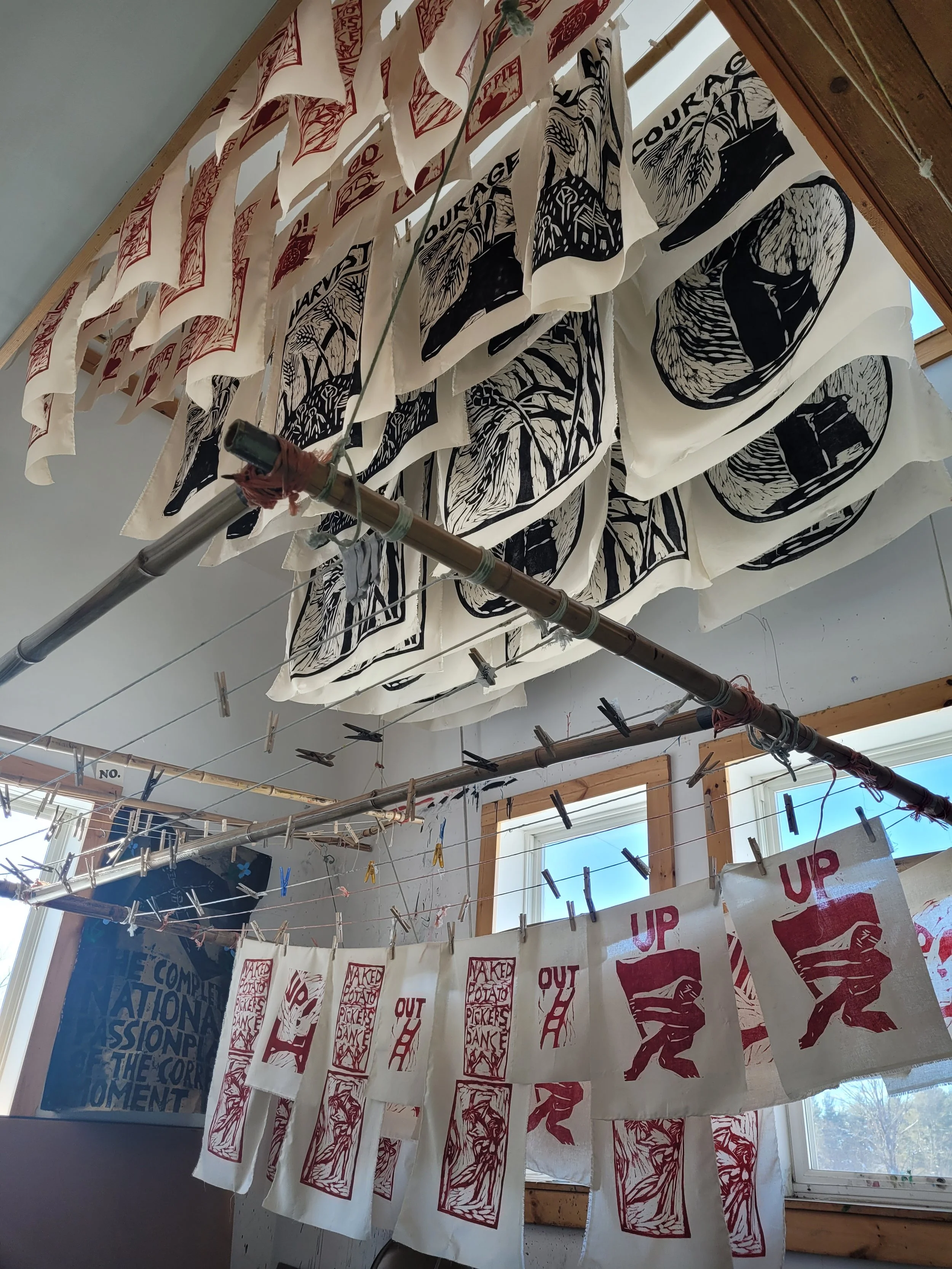
In the legacy of Bread and Puppet, we've worked with local artists to do block prints, we do a lot of card-making. Some of it has really explicit political messages, some of it is like, a goat, or a pig print that the children love, and sort of something for everyone as a way to bring people in, and then have that initial conversation. We also had really good luck with group banner paintings that we could then bring to protests and demonstrations and events all over the place. What else?
MC: Song.
MW: Song, absolutely. We were just talking about this in relation to work brigades in particular. I think it kind of relates to this idea of mística also, just like creativity and spirituality and making sure that that's also a core tenet of what we're trying to do and one of the ways that we are grounded in our own place and our own culture. We also make all our own merchandise, there's a lot of silk screening going on. Some of it is better than others [laughter]. It varies. But it's also a way that we can, we don't have a big budget at all. We try to do a lot with a little, and that's true for both the School and for Rural Vermont. But it's just one of those ways-- so we've talked about work brigades, and one of the ways that we think they work really well is because it breaks down the barriers between us. You're like, getting sweaty and stinky and dirty together, and it's sort of similar when you're making art together, like, you're getting messy, it's not perfect, it's never going to be perfect, you're totally going to screw something up, and it's actually what makes it beautiful. It comes up differently than we intended. It's one of those things that can break down the differences in between us.
Because I think one of our major barriers in doing this work in the United States is working against this culture of individualism, and just really extreme economic precarity, and trying to get farmers and members of the agrarian community to do something, and to show up and do something above and beyond what they're already doing, when we know that it's so hard to leave the farm. Money is so, so tight, it's really difficult. It's one of the ways, just creating a space where people can have a good time and be joyful together is actually a really great way to get them to show up.
V: Yeah. I've also heard from a friend of mine on this trip that one of the unique things about Vermont is there is a culture of cross-generational friendship cultivated through things like old-time music schools and camps and contra dancing. These culturally specific things that Vermont has that enable ongoing relationships between young people and elders and everyone in between, that is distinctive to here. I also see it in my mountains where I'm from at the other end of this range. And it isn't everywhere. Not everywhere has those spaces.
MC: I'm curious-- I will now push at this question, because I think it's an interesting one. There's also a culture of shared meals, like potluck, kind of. Not the burden that someone cooks it all for everyone, but instead that in places where you live out of sight of each other, there are these moments when there's a full moon bonfire, and everyone gathers to go on a night ski and hang out and sing. Those are often very mixed in terms of generation, because they'll be the pack of kids on their own, and then all of the ages of people from twenties to elders. And I don't know, I don't see that kind of exchange happening as much in cities. That might just be who my culture is.
MW: I think the brigades and the short course are also good examples for bringing together people from across a really broad generational perspective. Brigades in particular, I think-- there's always elders, and there's always children, it seems like. And that's not mandatory, but it just happens, pretty much every time. And there's such a richness that comes from both of those spaces. Especially with the brigades, if there's someone in the mentor role, they're not necessarily working alongside us. But at lunch, they are honored and they are given space to share their story and just be recognized for the gifts that they've given that particular farm. That's been a really beautiful and sort of unexpected piece of the brigades.
I also think about some other initiatives that the School has been working on, including something called the Food Sovereignty Growers Project. We ran a pilot program last year, and it was very, very small, and we're sort of reassessing what makes sense to do this year. But we know there's a lot of potential. It's this idea that links older, retiring farmers up with food pantry clients who are interested in growing food to act as mentors so they can scale up home production and then be able to sell it back to the food shelves. That's another lens that we are looking at as far as potential educators for the School. There's plenty of people that are farming and are amazing educators and want to do it all, and then there's also a large number of aging farmers in Vermont and across the country that are running up against physical limitations with their body, but have so much to offer. We're figuring out how we can plug those people in and continue to learn from them as we learn ourselves.
V: Do you have any other examples of, either an obstacle to handing on information or a way in which you've seen it be successful? Because I do think that is a continual challenge. Over and over and over again. I'm thinking about friends who work in land transfer organizations, and I think we've all seen the really visceral challenge of that handing over of stewardship, for so many reasons-- economic and historical and personal and health and medical related. I kind of have this hypothesis that there's similar challenges with the knowledge transfer, because it's connected to that land transfer. And so if y’all have other times you've seen those obstacles come up or seen ways of working through them.
MW: I don't know if this is exactly what you're getting at, but I'm thinking about a lesson that I really learned in Cuba which was that you have to see it to believe it., which I also have learned from farmers here. You can talk about something all damn day and someone who's farming is going to take it a lot more seriously if they can see it, and talk to the person who's doing it themselves. So I think this farmer-to-farmer methodology that is utilized all over the world, but really championed in Cuba, is another one of the principles that we've seen work, and that has been working here as well.
MC: I don't quite have this as succinct as I want to, but...connected to that but slightly different is the generational-- "stickyness" is the best word I can come up with. Like, watching my partner and his parents, and the difference between, 'I'm doing it this way because I've always done it this way' or 'I'm doing it this way because it's what's going to work best', and those are not always the same. Sort of like in Participatory Action Research we always talk about the important role of the facilitator in a space, and I often wonder what would happen with some of these intergenerational relationships, where there's pride and power and experience and frustration all kind of coming to a head around something that everybody loves-- like, what would be the power of a mediating source? Because it seems like so many of these relationships take a really hard hit. Partly because we don't know how to navigate that. I don't know if that's an information problem, but it's a communication problem. And is there a difference?
V: I love how you've articulated that. I'm hearing about experimental programs to connect older land stewards with younger people who need land, and if you have a very simple view of what the problems are-- this person needs land acquisition, this person needs a steward to help them as they age in place-- this seems like the perfect solution. Kind of like people who are like, 'oh, we'll put the preschools in the nursing homes and we'll solve all of our problems.' That only works if you have a very simple model of what each of those problems actually is. And then there's so, so, so many ways, over and over again, in which the actual challenges prove impossible to overcome in the context of a relationship, with each other, and with that land. And it's hard to talk about, because everyone's like, 'I'm built different though.' 'It won't happen to me, though.'
MC: Right! Right, because we want to be hopeful. Like, I think that's a good instinct.
V: And it's a problem we have to solve somehow.
MC: And I don't think that this is an AI-able...do you know what I mean? [laughter] Like, this is where I think that actually the reliance on technology potentially hurts us, because that nuance of like, how do you feel? Gets somehow just discounted.
MW: Yeah. And at the end of the day, farmers are humans, and if we don't have access to basic human needs, then it's going to make having these conversations a lot more difficult, when there's realities like health care and a lack of retirement savings and stuff like that. Really tangible, material needs that are really hard to come by when you spend your life farming, and that are necessary, and it just exacerbates the already really prevalent affordability crisis with land for farmers. That's a huge component of why it's so hard, I think, is because we don't have access to meeting these basic needs in a really fundamental way.
And again, I think, this is a little bit off topic, but it's been hammered into us by one of our folks who's been accompanying us, that the agroecology school itself isn't the movement-building space; it's a tool for building the movement. The movement- building space is actually this member organization that has grassroots leadership, that is working on, whether it's policy change or systemic change or cultural change, or whatever it may be, there's a link there. That's a model that we've really taken from what has worked well elsewhere, and also, hopefully, will continue to work well in our own context in order to both build what we need and try to create these structures and opportunities for real human relationship deepening. And then also have this other arm, and how to make the harm reduction changes, or whatever changes that need to be made now. That we can't do it all, but we have this relationship with this organization that is actually doing that work, that can help regain some of that.
V: That reminds me again of the conversation I had with the BALE folks, Building a Local Economy.
MW: Chris Wood? He's one of the founders of Rural Vermont.
V: Yes!
MW: Yeah, I'm sure he told you that, yeah!
V: I think I heard them say, you know, we're getting some pressure to focus and specialize, and do one thing. And they were like, we're actually not going to. We're going to keep being a place where many different things can move out of and into the space. And I think that that's so valuable to have that perspective of that knowledge in yourself, of whether you want to do one thing or do many things. Because both are possible. And again, we also talked about the challenge of presenting that to funders. But then the value of still being like, 'well, I'm doing it.'
MC: Yeah. Because it's what we need, right?
V: So I'm wondering-- I feel like I've taken a lot of your time [laughter], I've got another meeting I have to go to in about an hour, but if there are any other projects related to this that you think that I should have at the top of my mind, or stuff you're excited about, that you're working on, that you think more people should hear?
MW: I'd be surprised if they haven't come up already, but Vermont is the home base of Migrant Justice, which is a farm worker led organizing group. Their current campaign is Milk With Dignity. They've also been doing a lot of fundamental human rights triage, and supporting getting people to show up in the streets, rallying around immigration hearings and support for all of the sort of disgusting business that's happening there. They've been around since the early 20 teens, I believe, and work directly with the migrant farm worker community to create this program called Milk with Dignity that brings much more dignity to the supply chain at different points, but it also takes the onus off the farmer to make capital investments. Because we know that dairy farmers don't have the money to make really necessary improvements into working conditions and wages and housing and all of it, but the CEO of Hannaford, which is our local grocery, does. It worked really well with Ben and Jerry's, they were successful in getting them on board, and the working conditions for farms that are part of Milk With Dignity can be pretty stark in contrast to those that aren't. So we have this formula for what works, it's the worker driven social responsibility network or model that comes from the Immokalee workers in Florida. That would just be a really good group to have on your radar. They do awesome, awesome things that are really important to the agricultural system here.
V: Yeah, amazing. I've heard about the Hannaford boycotts and one of my friends is always rocking their Milk With Dignity sweatshirt [laughter].
MW: That's awesome.
V: But I don't think anyone's mentioned them as a project under the same shelter of similar work that you're doing, because y'all are the first--I mean, aside from Bread and Puppet-- orienting around political work. Most of the folks I've talked to are either around art, or around maybe just farmer education of skill and knowledge transfer. So I'm so happy that I got both of your perspectives.
MC: Yeah. And I would say, in tandem, Migrant Justice was born out of the same building where the Vermont Worker's Center lives, and so they have always been sort of sibling organizations to each other. And the organizing that the Worker's Center has done around access to health care in Vermont has also been profound. So again, thinking about the common roots, there are lots of people who were formatively part of those groups who then have moved on to be part of other spaces. Thinking about Rural Vermont really focusing in on the care economy, and how impossible it is to stay, for there to be a working landscape, if those-- elder care, child care, health care, if those are not being tended, then it doesn't matter what you do in policy to try to incentivize folks. They actually can't take the risk unless those bases are covered. So trying to help folks understand that political mandate has been part of all of those groups' work, from different pie slices.
MW: Not to transition us, but since we're talking about really incredible organizations that have had a crazy impact, the Center for an Agricultural Economy in Hardwick would be another one. They're another organization that we collaborate with very closely in a number of different ways. They do so many things, it would be probably easier and better for you to just look it up and get it in their words than me trying to paraphrase, but one of the things that they do is they have this program called Farm Connects which is like a distribution network and it gets local products into stores, but it also, to get back to your point about collaboration, it also distributes a huge amount of local products between different farm's farm stands, so they can provide more of the grocery store/farm stand experience. That sounds awful, but it actually is really important to community food sovereignty and security. And, I think again, goes back to a regulatory environment that we have that makes that legal, and that's really strong direct sale opportunities for farmers. It can definitely be improved, but the fact that farmers can ship their products directly, there's a service that helps them bring, like, my cheese to Martha's farm stand because I live on a dead end dirt road but you live on the best thoroughfare ever and get all the customers. And so it allows for a different level of cooperation, and it's a paid service, for sure.
MC: But it's a paid service that doesn't make money. [laughter]. It loses money.
MW: Yeah, exactly. They certainly didn't have to do that…And then we mentioned them already, but the Northeast Organic Farming Association of Vermont has been doing a lot of farmer-to-farmer educational training for decades now.
V: I was hoping I would overlap with the conference, and it didn't quite work out. But I've been working with Grace Gershuny through the Institute for Social Ecology, and so she's got tons of background on them, like, wrote the book. That's been really helpful. That was kind of what got me into this part of Vermont; I came and did an artist residency at the Sable Project this summer and I met a person who was organizing in Kentucky with the Institute for Social Ecology. We both met at the artist residency, I went to see them in Kentucky, they were like "join the mentorship program!" and I got Grace as my mentor. So it was like this perfect little loop.
MC: Oh, I love it.
V: That's been so incredible and helpful and never would have happened if I hadn't shown up here, in person.
MW: Grace was on our board back in the day, I believe, and I think Kali Acuno is still on the board for the Social Ecology institute, and was also part of the Political Pedagogical Coordination group that was originally scheming for the School.
V: That makes sense. I haven't met Kali but I did meet Michelle.
MW: Oh yeah, you just saw Michelle! Michelle's great.
V: Yeah! And that was, you know, I was totally just ignoring all of my 'work' and going to be by myself in the woods, and then it's like, well, the work comes and gets you wherever you are.
Rural Vermont
Martha Caswell & Mollie Wills
Barre, VT - February 2
Vic Spindler-Fox: I'd like to talk about why we're in this specific place rather than in the digital ether. [laughter] And then talk about what brought you to where you are, and maybe just hear about what you're doing. I'm also really interested in the idea of commoning and commons that's come up in a few calls... I got connected through Rural Vermont, so I'd love to hear about that and the People's School for Agroecology. And then your project ancestry. Whose ideas got you to where you are, trace that path for me. And then we can talk about the other groups I've talked to, and we can draw little lines connecting them.
Mollie Wills: Maybe I can talk about ancestry. I'll talk about Rural Vermont and ancestry of the school internationally, but you can talk about ancestry of the institute and local stuff? Cool. So I'm the director of grassroots organizing at Rural Vermont, and we've been around since 1985. We're founded in response to the farm crisis, because farmers were lacking political power and political voice and agency, and going under every single day. So we were founded by farmers, specifically to be a political voice. A lot of our early work was direct action based, we were organizing milk dumps with dairy farmers in particular, because of international trade policies that meant that people here were left high and dry. We've been involved with and have been a member of La Via Campesina since it was founded in 1993 through our membership with the National Family Farm Coalition and we have always had strong relationships with the national and international community through those relationships, and have had farmers throughout the past few decades participating in international exchanges, as well as hosting leaders from Via. We met one of the founders of Via in Sri Lanka and he hilariously was asking us 'Is this organization called Rural Vermont still around? I stayed with these farmers 30 years ago..." and it was hilarious because Martha and I were both there repping our Rural Vermont members.
So that was the start of involvement with La Via Campesina. Fast forward 20 years, and enter a person named Nils McCune who you may know through Float or other work, who was the staff person for Via North America, and Nils had also done a lot of personal research with his doctorate on these agroecology schools with La Via Campesina, and so he was sort of the introduction that I had into that space and the world, and was immediately really interested in these popular education training spaces and wanted to learn more about them. So started to do that through work with, it was the Climate Justice Collective at first, and then the Agroecology Seeds and Biodiversity Collective with La Via North America. Nils was also a staff member of Via North America, and is a current staff member with the Institute for Agroecology at UVM, so he was coming to Vermont for other reasons, and we were able to organize a meeting with a bunch of Rural Vermont members-- farmers, educators, and activists, and leaders from Via North America, as well as some allies regionally. Someone from the political committee came down from Canada, we had some regional farmers from the northeast, and we all sat around the bonfire and sort of kicked around this idea of, "what if we started one of these schools?'